Draveliqor
Vertex Module
Vertex Module
Couldn't load pickup availability
1. Problem Statement — When Separate Changes Become Connected
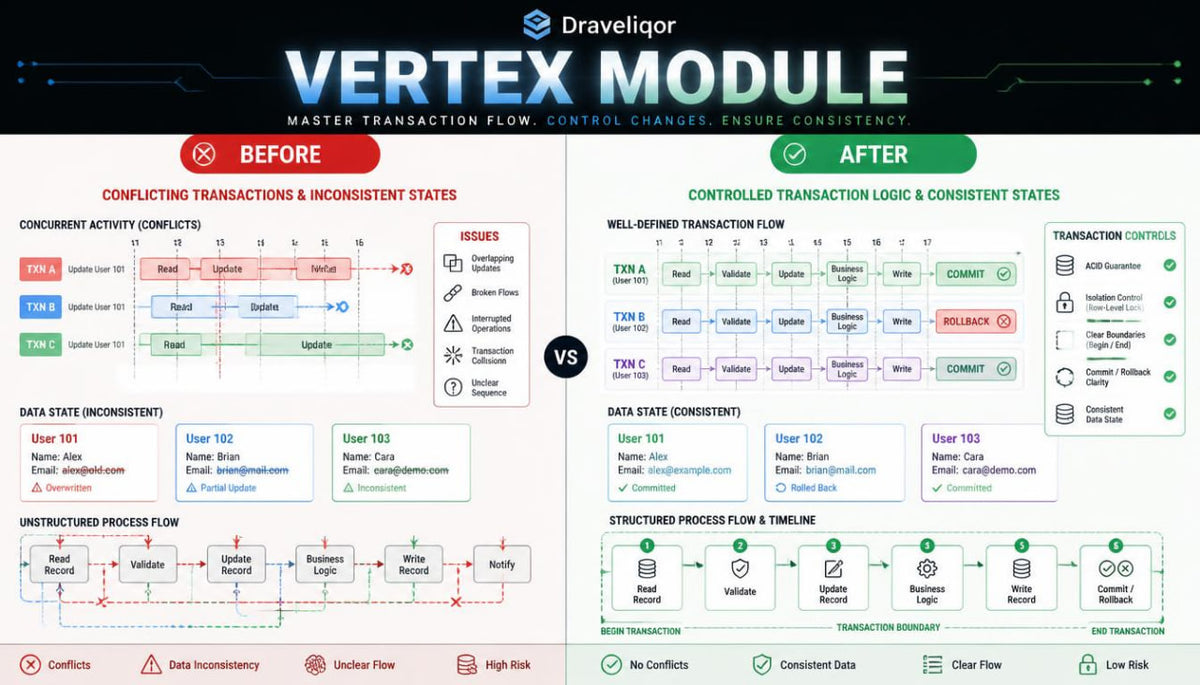
Database operations often involve several related records that need to be modified as part of the same activity. When individual changes are handled without considering their relationships, incomplete updates and conflicting information can affect the consistency of stored data. Multiple operations occurring close together introduce additional questions about transaction order, shared records, and the visibility of changing values. Learners familiar with database schemas and queries may still find it difficult to understand how a database coordinates updates while preserving defined structural rules. Studying transactions, isolation concepts, and integrity mechanisms provides a foundation for examining how related database operations are organized.
2. Solution — Understanding the Rules Behind Every Change
Vertex Module introduces database transaction concepts through a structured sequence of lessons focused on coordinated operations and record consistency. Readers begin by examining individual data modifications before exploring transactions containing several connected changes. The course explains atomicity, consistency, isolation, and durability through fictional database scenarios and illustrated examples. Guided exercises invite learners to interpret transaction sequences, identify conflicting operations, and consider how different isolation approaches affect shared information. A concluding workshop combines these concepts in a database planning scenario involving registrations, inventory records, and coordinated updates.
3. What's Inside — The Architecture of Database Changes
Vertex Module contains eight learning modules dedicated to understanding how database operations interact with stored records, relational structures, and concurrent activities.
The materials combine conceptual explanations, operation timelines, transaction diagrams, worked examples, and practical reasoning exercises.
Module 01 — Understanding the Nature of a Database Operation
Every modification begins with an instruction that changes the state of stored information.
This module introduces operations that create, modify, or remove records and examines their relationship to database integrity.
Readers explore the distinction between reading information and changing information.
Examples involving fictional inventory collections demonstrate how a modification to one record may influence related information.
Topics covered:
-
Data modification concepts
-
Record creation and removal
-
Updating existing values
-
Database state
-
Operation sequencing
-
Structural consistency
Practical activity: Examine a series of fictional record modifications and describe how the database state changes after each operation.
Module 02 — When Several Operations Form One Transaction
Some database activities involve multiple modifications that belong to a single logical operation.
This module introduces transactions and explains how related changes can be grouped.
Readers examine a fictional equipment reservation scenario in which a reservation record and an availability record must be updated together.
The lessons distinguish the boundaries of a transaction from the individual instructions performed within it.
Topics covered:
-
Transaction definitions
-
Transaction boundaries
-
Coordinated modifications
-
Commit operations
-
Rollback operations
-
Transaction states
Practical activity: Identify which database modifications belong together within several fictional information management scenarios.
Module 03 — Four Principles of Transaction Behavior
Database transactions are commonly described through four related principles: atomicity, consistency, isolation, and durability.
This module examines each principle independently before exploring how they work together.
Readers consider examples involving incomplete modifications, concurrent transactions, and changes that have already been committed.
The lessons use transaction timelines and sample records to illustrate the role of each principle.
Topics covered:
-
Atomicity
-
Consistency
-
Isolation
-
Durability
-
Transaction completion
-
State transitions
Practical activity: Analyze several transaction scenarios and identify which principle is relevant to each situation.
Module 04 — What Happens When an Operation Stops
Not every database operation reaches its intended completion.
This module examines transaction interruptions, failed modifications, and the conceptual role of rollback mechanisms.
Readers explore how incomplete operations differ from committed changes.
The lessons introduce recovery-related terminology, transaction logs, and the relationship between recorded operations and database state.
Examples focus on identifying which changes should remain and which should be reversed after an interruption.
Topics covered:
-
Transaction interruption
-
Rollback behavior
-
Commit confirmation
-
Recovery concepts
-
Transaction logs
-
Incomplete operations
Practical activity: Trace a fictional transaction containing several changes and determine the expected database state after an interruption.
Module 05 — When Operations Overlap
Multiple database activities may involve the same records during overlapping periods.
This module introduces concurrency and examines why transaction order matters when shared information is modified.
Readers explore sample timelines involving two transactions reading and changing related values.
The lessons introduce lost updates, dirty reads, non-repeatable reads, and phantom reads as distinct concurrency phenomena.
Topics covered:
-
Concurrent transactions
-
Shared records
-
Lost updates
-
Dirty reads
-
Non-repeatable reads
-
Phantom reads
-
Operation interleaving
Practical activity: Compare transaction timelines and identify how the order of operations influences the visible data.
Module 06 — Isolation and the Visibility of Changes
Database transactions can operate under different isolation rules.
This module examines common isolation levels and their relationship to concurrent operations.
Readers explore how transaction isolation influences which modifications can be observed before or after another transaction completes.
The lessons introduce locking and version-based concurrency concepts without requiring administration of a live database environment.
Topics covered:
-
Transaction isolation
-
Read committed
-
Repeatable read
-
Serializable isolation
-
Introductory locking
-
Version-based concurrency
Practical activity: Interpret several concurrent transaction scenarios and compare the behavior permitted by different isolation rules.
Module 07 — Constraints During Coordinated Updates
Transactions operate within the structural rules established by a database schema.
This module explores how integrity constraints interact with modifications to related records.
Readers examine primary key restrictions, foreign key references, unique values, and validation conditions.
Examples demonstrate how a transaction may be rejected when a proposed change conflicts with a defined rule.
The module also explores the importance of reviewing related records before planning coordinated modifications.
Topics covered:
-
Constraint validation
-
Referential integrity
-
Related record modifications
-
Invalid updates
-
Transaction rejection
-
Integrity review
Practical activity: Examine proposed changes to connected tables and identify potential constraint violations.
Module 08 — The Coordinated Operations Workshop
The final module combines transaction principles, integrity rules, and concurrency concepts within one practical planning activity.
Readers work with a fictional equipment lending center containing item records, reservations, borrowers, and return information.
The scenario includes overlapping reservations, changes to item availability, interrupted modifications, and relationships between transaction records.
Learners prepare transaction sequences, identify possible conflicts, and explain suitable handling approaches.
The workshop concludes with a review of transaction boundaries, consistency requirements, and the expected database state after each scenario.
Topics covered:
-
Transaction planning
-
Multi-table modifications
-
Concurrency analysis
-
Integrity constraints
-
Interruption handling
-
Database state evaluation
Practical activity: Develop and document a coordinated transaction model for a fictional database containing several connected information collections.
Supporting Learning Materials — Reading Between the Operations
Vertex Module includes sample transaction timelines, illustrated database states, terminology references, and exercises that encourage independent analysis.
Worked examples demonstrate how changing the order of operations can produce different outcomes.
Comparison activities invite learners to identify transaction boundaries, interpret isolation behavior, and review conflicts between related modifications.
A concluding knowledge review brings together transaction terminology, concurrency principles, integrity rules, and recovery concepts.
4. Who Is This For? — Exploring What Happens Behind an Update
Vertex Module is intended for readers who understand relational database structures and want to examine the behavior of coordinated data operations.
It may be suitable for students studying database management, independent learners exploring transaction processing, and individuals interested in how relational databases organize changes to shared records.
Familiarity with tables, identifiers, relationships, constraints, and introductory data modification concepts is recommended.
The learning materials focus on transaction reasoning, illustrated scenarios, and structural analysis rather than live database administration.
Readers are encouraged to work through the transaction timelines and compare alternative operation sequences.
5. What You'll Learn — Understanding Every Step of a Transaction
Through the Vertex Module materials, readers can explore the following knowledge areas and practical skills:
-
Explain the purpose of database transactions.
-
Distinguish individual modifications from grouped operations.
-
Identify transaction boundaries within database activities.
-
Describe commit and rollback behavior.
-
Explain atomicity, consistency, isolation, and durability.
-
Interpret transaction states and operation sequences.
-
Recognize incomplete and interrupted transactions.
-
Describe the purpose of transaction logs.
-
Examine concurrent operations involving shared records.
-
Identify lost updates and common read anomalies.
-
Compare introductory transaction isolation levels.
-
Explain the conceptual role of locking.
-
Recognize version-based concurrency approaches.
-
Identify integrity violations during coordinated updates.
-
Interpret transaction timelines and resulting database states.
-
Prepare a transaction outline for a fictional relational database.
-
Document relationships between transaction behavior and structural constraints.
These learning objectives describe the topics and activities included in Vertex Module. Readers can review individual examples and repeat the reasoning exercises as part of their independent study.
6. 30-Day Refund Information — Course Purchase Terms
Vertex Module is a paid educational course within the Draveliqor collection.
A 30-day refund option applies where the store's published Refund Policy establishes that period and the purchase meets its stated eligibility conditions.
Under such terms, eligible customers may submit a refund request within 30 calendar days of their purchase date.
Self-paced learning overview
- 📦 Digital file available after purchase
- 🔄 Long-term availability
- 🛡️ Secure checkout
- 🔄 Content updated in 2026
What subjects are covered in Draveliqor courses?
What subjects are covered in Draveliqor courses?
Draveliqor courses explore database concepts, information organization, data relationships, query structures, and practical data management methods. Each course follows a defined topic sequence, with learning materials arranged around explanations, examples, and exercises.
Do I need previous database knowledge before enrolling?
Do I need previous database knowledge before enrolling?
The recommended background depends on the course. Introductory materials explain foundational concepts, while later courses examine more detailed database structures and workflows. Reviewing the course description can help you select a suitable starting point.
What learning materials are included in each course?
What learning materials are included in each course?
Course content is organized into written lessons, topic explanations, illustrated examples, practical activities, and review questions. The specific subjects and activities are described in each course outline.
Share