Draveliqor
Slate Blueprint
Slate Blueprint
Couldn't load pickup availability
1. Problem Statement — When a Database Needs More Than Tables
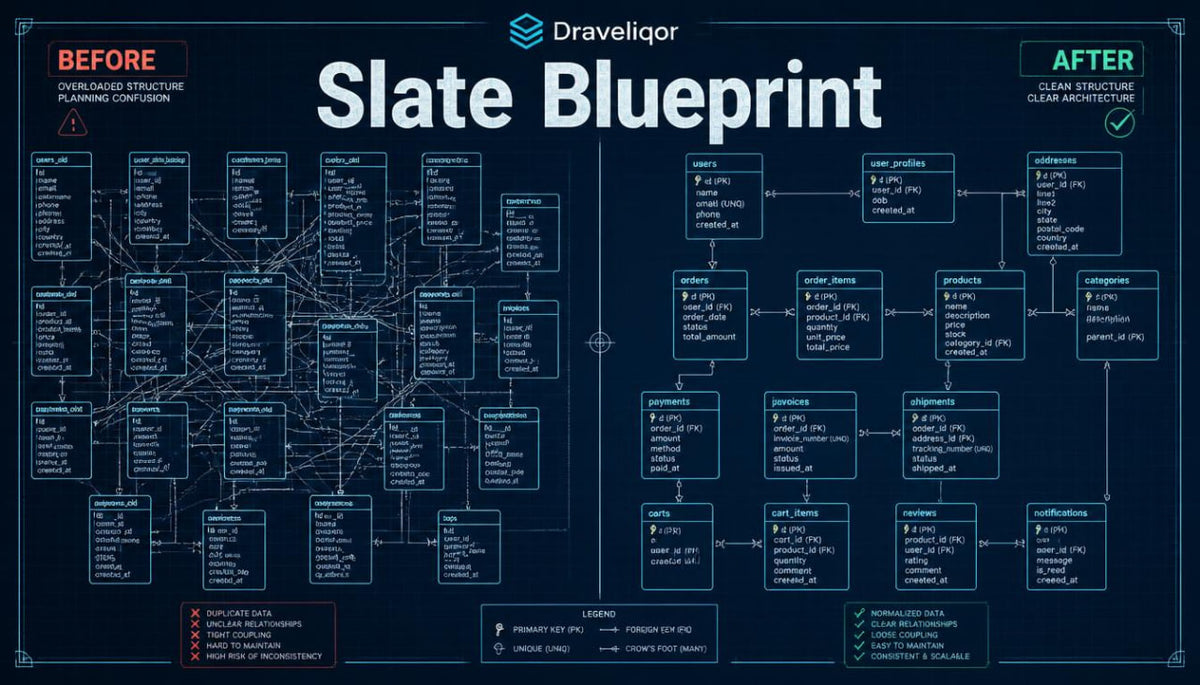
Creating a collection of database tables is only the beginning of designing a coherent information structure. As relationships become more detailed, unclear field definitions, repeated values, and inconsistent identifiers can introduce problems that are difficult to recognize during initial planning. Learners who understand basic relationships and queries may still find it challenging to translate written requirements into a complete database schema. Decisions concerning data types, table separation, constraints, and structural dependencies require careful consideration of how information will be stored and maintained. Studying database design principles provides a framework for examining these decisions and understanding how individual components contribute to an organized relational model.
2. Solution — Designing the Structure Before the Records
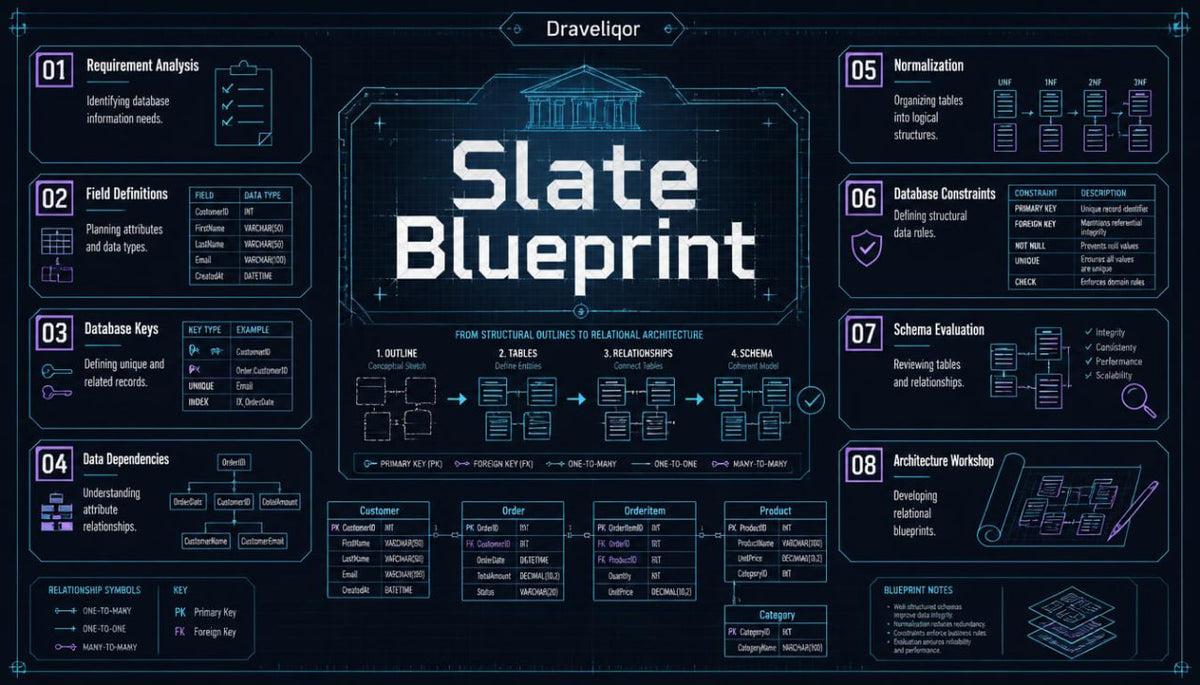
Slate Blueprint introduces a systematic approach to database schema planning through interconnected lessons and practical modeling activities. Readers examine how information requirements are interpreted, divided into entities, and represented through tables, fields, identifiers, and relationships. The course explores normalization principles, data constraints, and structural dependencies using fictional information systems that gradually increase in complexity. Guided exercises invite learners to compare alternative database arrangements and explain the reasoning behind individual design decisions. A concluding schema workshop brings the topics together through the development and review of a connected relational database blueprint.
3. What's Inside — From the First Sketch to the Finished Schema
Slate Blueprint contains eight learning modules covering relational database architecture, schema organization, data modeling, and structural evaluation.
Each module introduces a particular design concept, demonstrates its role through examples, and includes practical activities that encourage thoughtful database planning.
Module 01 — The Blueprint Begins with Requirements
Before defining tables, a database designer needs to understand the information being represented.
This opening module examines how written descriptions can be analyzed to identify relevant entities, attributes, and relationships.
Readers work with fictional scenarios involving activity centers, educational collections, and inventory records.
The lessons distinguish information requirements from assumptions introduced during structural planning.
Topics covered:
-
Interpreting database requirements
-
Identifying information categories
-
Recognizing entities and attributes
-
Documenting relationships
-
Preparing initial structural outlines
Practical activity: Analyze a fictional organization and prepare a written list of entities, attributes, and relationships for its proposed database.
Module 02 — Giving Every Field a Purpose
A database schema depends on clear definitions for the information contained within each table.
This module explores field selection, naming conventions, data types, and the distinction between required and optional values.
Readers examine how different types of information influence structural decisions.
Examples demonstrate why dates, numerical values, descriptive text, and identifiers should be represented according to their intended meaning.
The module also introduces default values and introductory field validation concepts.
Topics covered:
-
Field definitions
-
Data type selection
-
Naming conventions
-
Required and optional fields
-
Default values
-
Field-level validation
Practical activity: Prepare a field specification sheet for three connected tables, describing the purpose and intended format of each attribute.
Module 03 — Identifiers That Hold the Structure Together
Records require identifiers that distinguish individual entries and establish relationships between information collections.
This module examines primary keys, foreign keys, candidate keys, and composite identifiers.
Readers compare different identification strategies through examples involving registrations, catalog entries, and connected activity records.
The lessons discuss the distinction between descriptive attributes and identifiers intended for structural reference.
Additional examples introduce the relationship between keys and database integrity rules.
Topics covered:
-
Primary keys
-
Foreign keys
-
Candidate keys
-
Composite identifiers
-
Unique constraints
-
Referential relationships
Practical activity: Review several table structures and propose suitable identifiers, explaining the reasoning behind each selection.
Module 04 — Understanding Structural Dependencies
Some database fields depend on other fields for their interpretation.
This module introduces functional dependencies and their significance within relational database design.
Readers examine how one attribute may determine another and how these dependencies influence the arrangement of information.
The lessons use simplified examples to distinguish meaningful relationships from accidental similarities between recorded values.
Particular attention is given to recognizing repeated facts within a single table.
Topics covered:
-
Functional dependencies
-
Determinants
-
Attribute relationships
-
Repeated information
-
Structural redundancy
-
Dependency analysis
Practical activity: Examine a fictional course registration table and identify dependencies between its attributes.
Module 05 — Normalization: Finding the Right Boundaries
Database normalization provides a structured method for reviewing how information is distributed across tables.
This module introduces first, second, and third normal forms through detailed examples.
Readers examine how repeating groups, partial dependencies, and transitive dependencies can influence schema organization.
The lessons demonstrate how a broad table can be separated into related structures while preserving meaningful connections.
Examples also explore insertion, update, and deletion anomalies.
Topics covered:
-
First normal form
-
Second normal form
-
Third normal form
-
Repeating groups
-
Partial dependencies
-
Transitive dependencies
-
Data anomalies
Practical activity: Analyze a fictional registration table and develop a revised relational structure through successive normalization stages.
Module 06 — Constraints That Define the Rules
A database schema represents not only information but also the rules governing that information.
This module examines constraints and their role in maintaining consistent record structures.
Readers explore requirements involving unique values, mandatory fields, valid references, and acceptable value ranges.
The lessons distinguish structural constraints from business rules that may require additional interpretation.
Examples demonstrate how constraints can be documented as part of a database blueprint.
Topics covered:
-
Primary key constraints
-
Foreign key constraints
-
Unique values
-
Required fields
-
Validation rules
-
Referential integrity
-
Constraint documentation
Practical activity: Create a constraint specification for a fictional database containing participants, activities, and registration records.
Module 07 — Reviewing the Shape of a Schema
A completed database diagram still requires careful examination.
This module introduces schema review methods and explores how structural choices can be evaluated against written requirements.
Readers inspect sample diagrams for missing relationships, unnecessary duplication, unclear identifiers, and incomplete field definitions.
The lessons also discuss the distinction between conceptual, logical, and physical database models.
Revision activities encourage readers to document why particular structural changes are proposed.
Topics covered:
-
Schema evaluation
-
Conceptual database models
-
Logical data models
-
Physical design considerations
-
Structural consistency
-
Design documentation
Practical activity: Review a proposed relational schema, identify organizational concerns, and prepare a revised diagram with explanatory notes.
Module 08 — The Relational Architecture Workshop
The final module combines the earlier lessons in an integrated database design activity.
Readers work with a fictional learning center that maintains information about courses, instructors, participants, study groups, and registrations.
The workshop begins with interpreting written requirements and identifying the entities represented within the scenario.
Learners then define fields, choose identifiers, establish relationships, examine dependencies, and review normalization considerations.
The closing activity involves presenting the proposed schema through diagrams, field specifications, and written explanations.
Topics covered:
-
Requirement analysis
-
Entity identification
-
Table and field planning
-
Relationship modeling
-
Normalization review
-
Constraint definitions
-
Schema documentation
Practical activity: Develop a relational database blueprint containing connected tables, defined identifiers, documented constraints, and a complete relationship diagram.
Additional Learning Materials — Details Behind Every Design Choice
Slate Blueprint includes supporting diagrams, sample datasets, terminology notes, and guided structural review exercises.
Worked examples demonstrate how an initial table arrangement can evolve through analysis, normalization, and constraint planning.
Readers can compare alternative schemas and consider how different organizational decisions affect the interpretation of connected information.
Review questions encourage learners to explain the purpose of individual design elements rather than simply identifying their names.
A concluding reference section brings together key terminology associated with relational structures, dependencies, normalization, and schema evaluation.
4. Who Is This For? — Readers Ready to Design the Structure
Slate Blueprint is intended for learners who understand introductory database concepts and want to study relational schema design in greater detail.
The course may be suitable for students exploring database architecture, independent learners interested in data modeling, and individuals who want to understand the reasoning behind table structures.
Familiarity with entities, attributes, identifiers, relationships, and introductory queries is recommended.
The materials focus on conceptual planning, structural analysis, and written design activities rather than the administration of live database environments.
Readers are encouraged to complete the modeling exercises and document the reasoning behind their proposed structures.
5. What You'll Learn — From Requirements to Relational Design
Through the Slate Blueprint materials, readers can explore the following knowledge areas and practical skills:
-
Interpret written database requirements.
-
Identify entities and their associated attributes.
-
Prepare structured field specifications.
-
Select data types according to information requirements.
-
Explain the roles of primary, foreign, and composite keys.
-
Recognize functional dependencies between attributes.
-
Identify repeated information within relational tables.
-
Explain the principles of first, second, and third normal forms.
-
Recognize insertion, update, and deletion anomalies.
-
Divide broad tables into connected relational structures.
-
Define introductory field and relationship constraints.
-
Distinguish conceptual, logical, and physical database models.
-
Interpret and develop relational schema diagrams.
-
Evaluate database structures against documented requirements.
-
Prepare a database blueprint with supporting design explanations.
These learning objectives describe the concepts and exercises presented within Slate Blueprint. Readers can revisit individual modules when reviewing structural decisions and developing their understanding of relational database design.
6. 30-Day Refund Information — Course Purchase Terms
Understanding the Refund Process
Slate Blueprint is a paid educational course within the Draveliqor collection.
A 30-day refund option applies to eligible purchases where the store's published Refund Policy provides these terms.
Where applicable, customers may submit a refund request within 30 calendar days of their purchase date, following the procedure described in that policy.
Self-paced learning overview
- 📦 Digital file available after purchase
- 🔄 Long-term availability
- 🛡️ Secure checkout
- 🔄 Content updated in 2026
What subjects are covered in Draveliqor courses?
What subjects are covered in Draveliqor courses?
Draveliqor courses explore database concepts, information organization, data relationships, query structures, and practical data management methods. Each course follows a defined topic sequence, with learning materials arranged around explanations, examples, and exercises.
Do I need previous database knowledge before enrolling?
Do I need previous database knowledge before enrolling?
The recommended background depends on the course. Introductory materials explain foundational concepts, while later courses examine more detailed database structures and workflows. Reviewing the course description can help you select a suitable starting point.
What learning materials are included in each course?
What learning materials are included in each course?
Course content is organized into written lessons, topic explanations, illustrated examples, practical activities, and review questions. The specific subjects and activities are described in each course outline.
Share