Draveliqor
Quantum Framework
Quantum Framework
Couldn't load pickup availability
1. Problem Statement — When Every Database Decision Affects Another
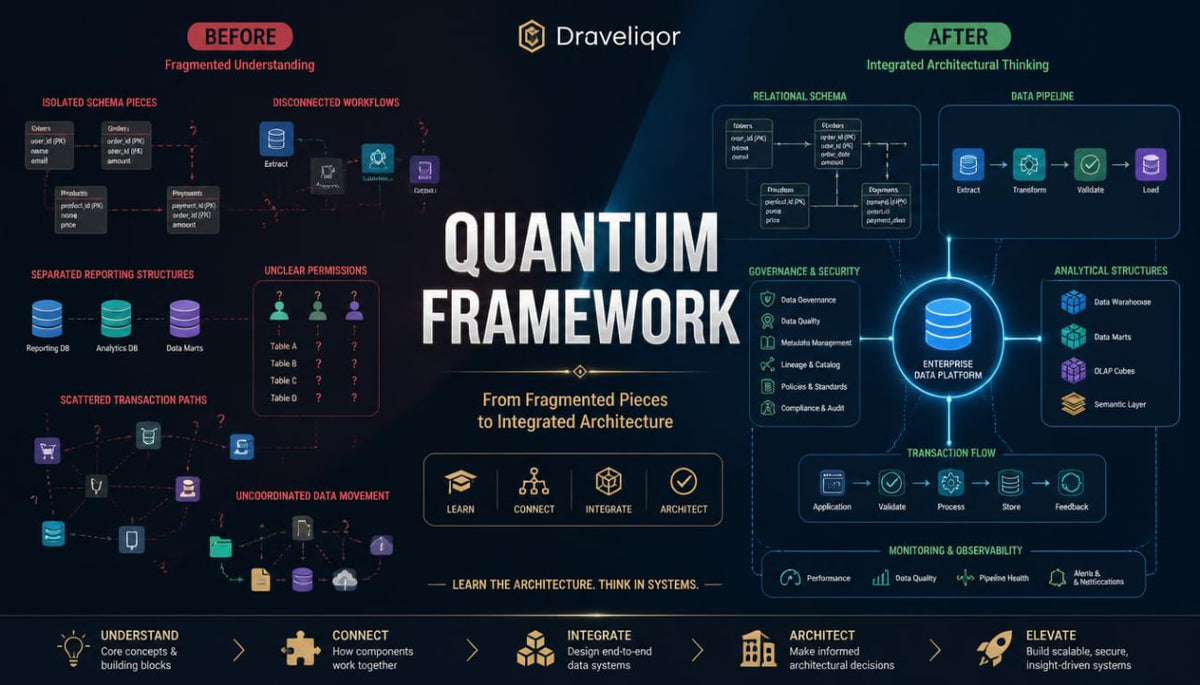
Complex database environments involve interconnected structures where changes to one component can influence several others. A schema may represent information clearly, yet additional considerations emerge when transactions, reporting requirements, historical records, and distributed components operate together. Decisions involving data organization, query behavior, consistency, and operational maintenance can become difficult to evaluate when examined as isolated subjects. Learners who understand individual database concepts may still find it challenging to combine those concepts into a coherent architectural design. Studying database architecture as an interconnected discipline provides a way to examine structural dependencies, document technical decisions, and evaluate alternative approaches.
2. Solution — Connecting the Layers of Database Architecture
Quantum Framework introduces an integrated approach to database planning through a structured sequence of technical lessons and applied activities. Readers examine how information requirements influence schema design, transaction behavior, data movement, query organization, and operational procedures. The course connects relational modeling with broader architectural concepts using fictional systems that contain multiple information collections and interacting components. Guided exercises invite learners to compare design alternatives, interpret technical diagrams, and document the reasoning behind architectural decisions. A concluding design workshop combines the studied concepts into a database architecture proposal with defined structures, information flows, maintenance considerations, and evaluation criteria.
3. What's Inside — Exploring the Architecture as a Whole
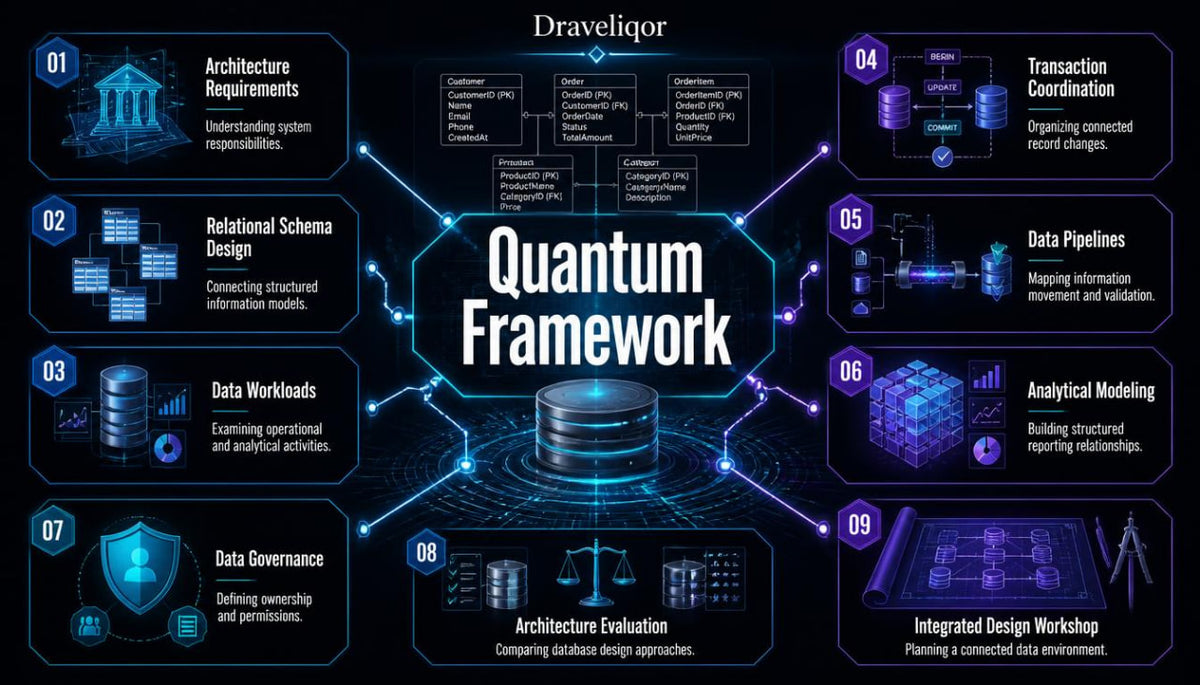
Quantum Framework contains nine detailed learning modules designed around integrated database planning and architectural reasoning.
The materials combine technical explanations, fictional information scenarios, relational diagrams, workflow illustrations, and structured evaluation activities.
Each module examines how individual database concepts interact with neighboring components rather than treating every topic as an independent subject.
Module 01 — Reading the Architectural Landscape
Database design begins with an understanding of the environment in which information will be collected and used.
This module introduces architectural requirement analysis and examines the distinction between information requirements, operational constraints, and structural preferences.
Readers explore how different activities create different expectations for data organization.
A fictional regional research center provides the initial scenario, containing researchers, projects, observations, reference collections, and reporting requirements.
The lessons also introduce architectural boundaries and the importance of recording design assumptions.
Topics covered:
-
Architectural requirement analysis
-
Information workflows
-
Database responsibilities
-
Structural boundaries
-
Technical constraints
-
Architectural documentation
Practical activity: Develop an architectural requirements document identifying the main information collections, operational activities, and structural considerations for a fictional research environment.
Module 02 — Designing the Relational Core
An integrated database environment requires a coherent structure for its primary information.
This module revisits relational modeling in the context of larger architectural arrangements.
Readers examine entities, attributes, identifiers, dependencies, and relationships across several functional areas.
The lessons explore how normalization decisions influence structural organization and how reporting requirements may introduce additional design considerations.
Examples demonstrate how a consistent relational core can connect information created through different activities.
Topics covered:
-
Integrated relational modeling
-
Entity boundaries
-
Relational dependencies
-
Schema normalization
-
Reference consistency
-
Structural documentation
Practical activity: Design a connected relational schema representing research projects, participants, observation records, and classification categories.
Module 03 — Understanding Workloads and Information Movement
Database structures respond to different patterns of information activity.
This module explores how reading, writing, updating, and summarizing records create distinct operational requirements.
Readers examine transactional workloads and analytical workloads through examples involving observations and research reports.
The lessons introduce data movement between operational tables and reporting-oriented structures.
The module also discusses the importance of identifying which information is needed by each activity.
Topics covered:
-
Database workload classification
-
Transactional operations
-
Analytical queries
-
Data movement
-
Reporting structures
-
Workload documentation
Practical activity: Analyze fictional database activities and prepare a diagram identifying where information is created, modified, retrieved, and summarized.
Module 04 — Coordinating Changes Across the Structure
Transactions are a central consideration when connected information collections are modified.
This module examines coordinated changes within relational databases and introduces broader architectural questions involving several data components.
Readers revisit transaction boundaries, isolation, consistency, and record integrity.
The lessons explore scenarios in which changes to research observations affect related summary records and historical information.
Examples illustrate the distinction between operations completed together and processes that exchange information through separate stages.
Topics covered:
-
Transaction boundaries
-
Coordinated modifications
-
Consistency requirements
-
Isolation considerations
-
Related record changes
-
Multi-stage workflows
Practical activity: Prepare transaction diagrams for a fictional observation workflow and identify where integrity checks and coordination decisions are required.
Module 05 — Building Clear Data Pathways
Information often moves between collection, validation, storage, and reporting stages.
This module introduces data pipeline concepts and examines how information is handled as it moves through a structured workflow.
Readers explore source records, staging areas, validation rules, mapping procedures, and destination structures.
The lessons introduce the distinction between initial data loading and subsequent updates.
Examples also demonstrate how documented transformation rules contribute to understanding the meaning of stored information.
Topics covered:
-
Data pipeline architecture
-
Staging structures
-
Data validation
-
Field mapping
-
Data transformation
-
Update handling
-
Information flow documentation
Practical activity: Design a conceptual data pipeline that receives fictional research observations, checks their structure, and organizes them for storage and reporting.
Module 06 — Historical Records and Analytical Structures
Information used for reporting may require a different organization from information used for everyday operations.
This module explores historical data structures and introductory analytical modeling.
Readers examine fact tables, dimension tables, and relationships between recorded activities and descriptive categories.
The lessons introduce dimensional modeling through fictional project observations grouped by location, date, and research category.
The module also considers how historical changes can influence reporting interpretations.
Topics covered:
-
Historical information modeling
-
Analytical database structures
-
Fact tables
-
Dimension tables
-
Dimensional relationships
-
Historical attributes
-
Reporting consistency
Practical activity: Prepare an introductory analytical schema and explain how it relates to the original operational database tables.
Module 07 — Permissions, Ownership, and Information Responsibilities
Database architecture also involves decisions about who can work with particular information and how changes are documented.
This module introduces database governance concepts, including data ownership, role-based permissions, and record accountability.
Readers examine the distinction between reading, modifying, and administering information.
The lessons explore audit trails, data classification, retention rules, and the documentation of information responsibilities.
Examples use fictional organizational roles rather than actual personal records.
Topics covered:
-
Data governance fundamentals
-
Information ownership
-
Role-based permissions
-
Data classification
-
Audit trail concepts
-
Retention planning
-
Responsibility documentation
Practical activity: Create a permissions matrix for a fictional research database and document which roles require different types of database operations.
Module 08 — Evaluating Architectural Decisions
Different database designs can represent the same information requirements while introducing different operational tradeoffs.
This module explores architectural evaluation through structured comparison.
Readers examine how schema organization, indexing, data distribution, and maintenance requirements influence design decisions.
The lessons introduce design decision records and the use of evaluation criteria.
A series of fictional proposals demonstrates how an architectural choice can be appropriate for one workload while introducing additional complexity for another.
Topics covered:
-
Architectural evaluation
-
Design alternatives
-
Workload considerations
-
Structural tradeoffs
-
Maintenance implications
-
Decision documentation
-
Architecture review methods
Practical activity: Compare three proposed database arrangements and prepare a written architectural evaluation explaining their differences.
Module 09 — The Integrated Database Design Workshop
The final module brings the earlier topics together in a substantial database architecture exercise.
Readers return to the fictional regional research center introduced at the beginning of the course.
The organization maintains research projects, participant details, observational records, classification references, historical information, and reporting collections.
The workshop begins with a review of information requirements and the preparation of a relational schema.
Learners then develop a data flow diagram, identify transaction boundaries, describe analytical structures, and outline information responsibilities.
The final stage involves documenting operational considerations and reviewing the proposed architecture against the original requirements.
Topics covered:
-
Integrated architecture planning
-
Relational schema design
-
Data workflow modeling
-
Transaction coordination
-
Analytical structures
-
Governance considerations
-
Operational planning
-
Architecture evaluation
Practical activity: Prepare a database architecture proposal containing connected schema diagrams, data movement illustrations, operational notes, and documented design decisions.
Supporting Learning Materials — From Individual Concepts to Connected Decisions
Quantum Framework includes architectural diagrams, fictional database scenarios, field mapping exercises, transaction illustrations, and structured design worksheets.
Additional review activities invite readers to compare different architectural arrangements and explain the reasoning behind selected approaches.
The materials also introduce documentation methods for recording assumptions, structural choices, and unresolved technical questions.
A concluding terminology reference connects concepts from relational modeling, data pipelines, analytical structures, transactions, and operational planning.
Together, these activities provide a framework for examining database design as a connected technical discipline.
4. Who Is This For? — Readers Exploring the Entire Data Architecture
Quantum Framework is intended for learners who already understand foundational database concepts and want to examine how multiple areas of database design interact.
The course may be suitable for students exploring advanced database architecture, independent learners interested in integrated information environments, and readers studying the relationship between data modeling and operational planning.
Familiarity with relational schemas, queries, indexing, transactions, and introductory distributed database concepts is recommended.
The materials emphasize architectural analysis, conceptual design, and technical documentation rather than the administration of a live information environment.
Readers are encouraged to work through the design exercises and review the relationships between individual architectural components.
5. What You'll Learn — Connecting the Entire Database Picture
Through the Quantum Framework materials, readers can explore the following knowledge areas and practical skills:
-
Interpret database architecture requirements.
-
Identify structural boundaries and information responsibilities.
-
Develop relational schemas for interconnected information collections.
-
Examine how normalization decisions influence database organization.
-
Distinguish transactional and analytical workloads.
-
Map information movement across database components.
-
Define transaction boundaries for related record modifications.
-
Explain coordination considerations in multi-stage workflows.
-
Describe the purpose of data staging and validation.
-
Create introductory data pipeline diagrams.
-
Recognize fact tables and dimension tables.
-
Develop conceptual analytical database structures.
-
Examine historical information requirements.
-
Describe introductory data governance principles.
-
Prepare role-based permission matrices.
-
Identify audit and record retention considerations.
-
Compare alternative database architectures.
-
Document structural tradeoffs and design assumptions.
-
Prepare an integrated database architecture proposal.
-
Evaluate proposed structures against documented requirements.
These learning objectives describe the concepts and exercises included in Quantum Framework.
The course emphasizes the relationship between individual technical decisions and the wider organization of information systems.
Individual progress depends on previous knowledge, participation, and time dedicated to the learning activities.
6. 30-Day Refund Information — Course Purchase Terms
Quantum Framework is a paid educational course within the Draveliqor collection.
A 30-day refund request period applies where this arrangement is established in the store's published Refund Policy and the purchase meets the stated eligibility conditions.
Under these terms, eligible customers may submit a refund request within 30 calendar days of their purchase date.
Self-paced learning overview
- 📦 Digital file available after purchase
- 🔄 Long-term availability
- 🛡️ Secure checkout
- 🔄 Content updated in 2026
What subjects are covered in Draveliqor courses?
What subjects are covered in Draveliqor courses?
Draveliqor courses explore database concepts, information organization, data relationships, query structures, and practical data management methods. Each course follows a defined topic sequence, with learning materials arranged around explanations, examples, and exercises.
Do I need previous database knowledge before enrolling?
Do I need previous database knowledge before enrolling?
The recommended background depends on the course. Introductory materials explain foundational concepts, while later courses examine more detailed database structures and workflows. Reviewing the course description can help you select a suitable starting point.
What learning materials are included in each course?
What learning materials are included in each course?
Course content is organized into written lessons, topic explanations, illustrated examples, practical activities, and review questions. The specific subjects and activities are described in each course outline.
Share