Draveliqor
Lattice Framework
Lattice Framework
Couldn't load pickup availability
1. Problem Statement — When One Database Becomes a Network of Decisions
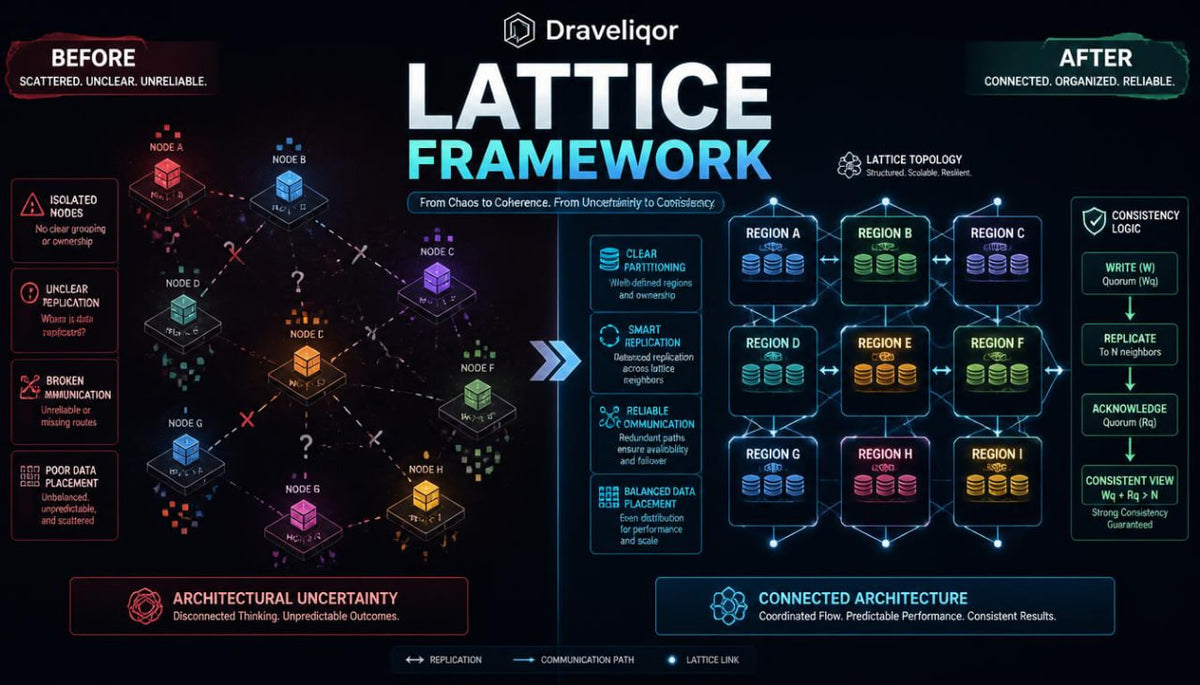
Database architecture becomes more complicated when information must be organized across multiple storage locations and processing components. Structures that work well within a single database may require additional planning when records are distributed, replicated, or shared between independent environments. Questions concerning consistency, data placement, communication, and system availability introduce relationships that extend beyond individual tables. Learners familiar with relational schemas and query operations may find it challenging to understand how these components interact within a broader architecture. Studying distributed database principles provides a foundation for examining these connections and evaluating the decisions involved in designing coordinated information environments.
2. Solution — Understanding the Architecture Behind Connected Data
Lattice Framework introduces database architecture through a sequence of lessons examining storage components, data distribution, communication, and consistency. Readers begin with centralized structures before exploring how information can be organized across connected database nodes. The course uses architectural diagrams and fictional information environments to illustrate replication, partitioning, distributed queries, and coordination methods. Guided exercises invite learners to compare structural arrangements, examine communication pathways, and document architectural decisions. A concluding workshop brings these concepts together through the design of a distributed information environment with defined data relationships and operational requirements.
3. What's Inside — From Individual Nodes to Connected Architecture
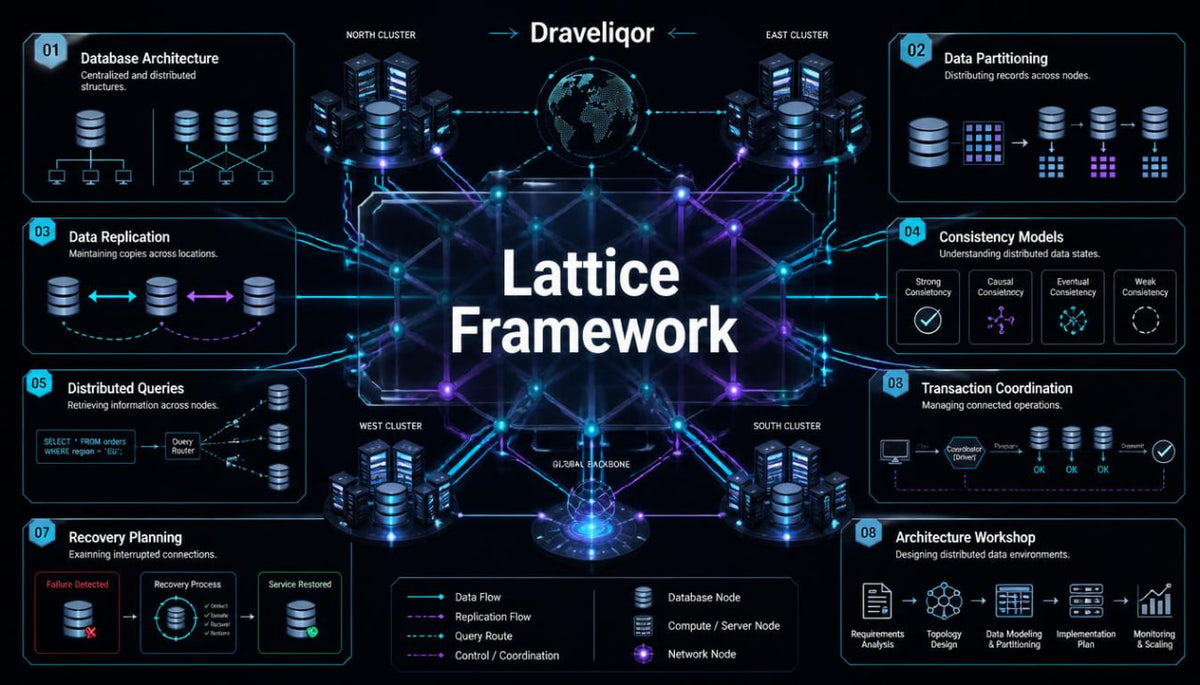
Lattice Framework contains eight detailed modules focusing on database architecture and distributed information management.
Each module combines conceptual explanations, architectural illustrations, example scenarios, and written design exercises.
Module 01 — Beyond the Single Database
The opening module examines how database architecture develops when information requirements extend beyond a single storage environment.
Readers compare centralized and distributed structures, identifying the responsibilities of individual components.
The lessons introduce database nodes, communication pathways, storage responsibilities, and the relationship between logical data models and physical deployment arrangements.
Topics covered:
-
Centralized database architecture
-
Distributed database concepts
-
Storage and processing nodes
-
Architectural components
-
Logical and physical organization
Practical activity: Create diagrams comparing centralized and distributed arrangements for a fictional information collection.
Module 02 — Dividing Information Across the Structure
Large information collections can be divided into separate groups according to defined organizational rules.
This module introduces database partitioning and explores how records can be assigned to different storage locations.
Readers examine horizontal and vertical partitioning, range-based divisions, and hash-based distribution concepts.
The lessons discuss how partitioning decisions influence retrieval patterns and record placement.
Topics covered:
-
Horizontal partitioning
-
Vertical partitioning
-
Range-based distribution
-
Hash-based distribution
-
Partition identifiers
-
Data placement strategies
Practical activity: Develop a partitioning plan for a fictional catalog containing records from several geographic regions.
Module 03 — Replication and the Movement of Records
Distributed environments may maintain copies of information across separate database nodes.
This module examines replication and the reasons an architecture may use multiple copies of stored records.
Readers compare synchronous and asynchronous replication through illustrated timelines.
The lessons explore how changes move between connected components and why temporary differences may appear between replicas.
Topics covered:
-
Data replication principles
-
Primary and secondary replicas
-
Synchronous replication
-
Asynchronous replication
-
Replication delays
-
Data synchronization
Practical activity: Interpret replication timelines and identify how updates are represented across fictional database nodes.
Module 04 — Consistency Across Connected Components
Coordinating information across different locations introduces questions about when updated values become visible.
This module examines consistency models and how they describe the behavior of distributed data.
Readers explore strong consistency, eventual consistency, and introductory read consistency concepts.
The lessons also introduce the relationship between consistency, availability, and network interruptions, including the scope of the CAP theorem.
Topics covered:
-
Distributed consistency
-
Strong consistency
-
Eventual consistency
-
Read consistency concepts
-
Network partitions
-
Availability considerations
-
CAP theorem fundamentals
Practical activity: Compare fictional distributed database scenarios and explain the consistency behavior illustrated in each example.
Module 05 — Queries That Cross Boundaries
Retrieving information from several nodes requires coordination between database components.
This module introduces distributed query processing and examines how information requests may involve multiple storage locations.
Readers explore query routing, partial results, aggregation, and communication between nodes.
Illustrated examples demonstrate why data placement can influence the number of operations needed to retrieve information.
Topics covered:
-
Distributed query processing
-
Query routing
-
Cross-node retrieval
-
Partial result aggregation
-
Communication costs
-
Data locality
Practical activity: Trace a query through a fictional distributed database and describe the role of each participating component.
Module 06 — Coordinating Changes Across Nodes
A change involving several database nodes can introduce additional coordination requirements.
This module examines distributed transactions and the distinction between local and cross-node operations.
Readers explore two-phase commit as an introductory coordination protocol, including preparation and completion stages.
The lessons discuss transaction participants, interruptions, and the challenges associated with maintaining coordinated database states.
Topics covered:
-
Distributed transaction concepts
-
Local and cross-node operations
-
Transaction coordination
-
Two-phase commit
-
Participant states
-
Failure scenarios
Practical activity: Construct a transaction timeline showing how several database nodes participate in a coordinated modification.
Module 07 — Designing for Interrupted Connections
Connected database environments may experience communication interruptions or temporary component failures.
This module introduces architectural considerations related to node availability, replication arrangements, and recovery planning.
Readers examine how different failure scenarios affect information retrieval and modification.
The lessons distinguish architectural redundancy from data preservation procedures and introduce monitoring concepts.
Topics covered:
-
Node failure scenarios
-
Communication interruptions
-
Replication arrangements
-
Failover concepts
-
Recovery planning
-
Operational monitoring
Practical activity: Analyze a fictional database architecture and document how selected interruptions may affect its operation.
Module 08 — The Distributed Architecture Workshop
The final module combines the earlier concepts in an integrated database design exercise.
Readers work with a fictional research organization maintaining records across several regional facilities.
The scenario includes shared catalogs, regional information collections, historical records, and coordinated updates.
Learners prepare an architectural diagram, propose data distribution rules, examine replication requirements, and describe query communication pathways.
The workshop concludes with an evaluation of consistency choices, recovery considerations, and structural tradeoffs.
Topics covered:
-
Distributed architecture planning
-
Node organization
-
Partitioning strategies
-
Replication arrangements
-
Consistency requirements
-
Distributed query design
-
Architectural documentation
Practical activity: Prepare a distributed database architecture proposal containing diagrams, structural explanations, and an evaluation of selected design decisions.
Supporting Learning Materials — The Details Between the Nodes
Lattice Framework includes conceptual architecture diagrams, distribution examples, replication timelines, terminology references, and guided analytical exercises.
Worked scenarios illustrate how changes to data placement, replication, and coordination rules influence database behavior.
Readers compare alternative arrangements and explain their architectural decisions through written evaluations.
A concluding review connects database distribution, consistency, transaction coordination, and failure handling within a single reference structure.
4. Who Is This For? — Readers Exploring the Wider Database Landscape
Lattice Framework is intended for learners who understand relational database structures and want to explore architectural concepts involving connected storage environments.
The course may be suitable for students examining distributed data organization, independent learners interested in database architecture, and readers studying how information is coordinated across several components.
Familiarity with tables, relationships, queries, indexing, and transaction principles is recommended.
Previous experience administering distributed infrastructure is not required.
The course emphasizes architectural reasoning, diagrams, and written planning activities rather than the operation of live database infrastructure.
5. What You'll Learn — Understanding the Architecture of Connected Data
Through Lattice Framework, readers can explore the following knowledge areas and practical skills:
-
Explain centralized and distributed database structures.
-
Identify common components within distributed architectures.
-
Distinguish logical and physical data organization.
-
Compare horizontal and vertical partitioning.
-
Describe range-based and hash-based distribution methods.
-
Explain synchronous and asynchronous replication.
-
Interpret introductory replication timelines.
-
Compare different distributed consistency models.
-
Describe the relationship between consistency and availability.
-
Explain the basic scope of the CAP theorem.
-
Trace information requests across database nodes.
-
Identify communication considerations in distributed queries.
-
Describe the purpose of distributed transaction coordination.
-
Interpret the stages of two-phase commit.
-
Recognize common node and communication failure scenarios.
-
Develop introductory recovery and replication plans.
-
Prepare architectural diagrams for connected databases.
-
Document structural tradeoffs in distributed environments.
These learning objectives describe the concepts and exercises included in Lattice Framework. Individual progress depends on previous knowledge, participation, and the time dedicated to studying the materials.
6. 30-Day Refund Information — Course Purchase Terms
A Clear Approach to Refund Requests
Lattice Framework is a paid educational course within the Draveliqor collection.
A 30-day refund request period applies to eligible purchases if this arrangement is established in the store's published Refund Policy.
Under these terms, eligible customers may submit a refund request within 30 calendar days of their purchase date.
Self-paced learning overview
- 📦 Digital file available after purchase
- 🔄 Long-term availability
- 🛡️ Secure checkout
- 🔄 Content updated in 2026
What subjects are covered in Draveliqor courses?
What subjects are covered in Draveliqor courses?
Draveliqor courses explore database concepts, information organization, data relationships, query structures, and practical data management methods. Each course follows a defined topic sequence, with learning materials arranged around explanations, examples, and exercises.
Do I need previous database knowledge before enrolling?
Do I need previous database knowledge before enrolling?
The recommended background depends on the course. Introductory materials explain foundational concepts, while later courses examine more detailed database structures and workflows. Reviewing the course description can help you select a suitable starting point.
What learning materials are included in each course?
What learning materials are included in each course?
Course content is organized into written lessons, topic explanations, illustrated examples, practical activities, and review questions. The specific subjects and activities are described in each course outline.
Share