Draveliqor
Free Node
Free Node
Couldn't load pickup availability
1. Problem Statement — When Information Has No Clear Structure
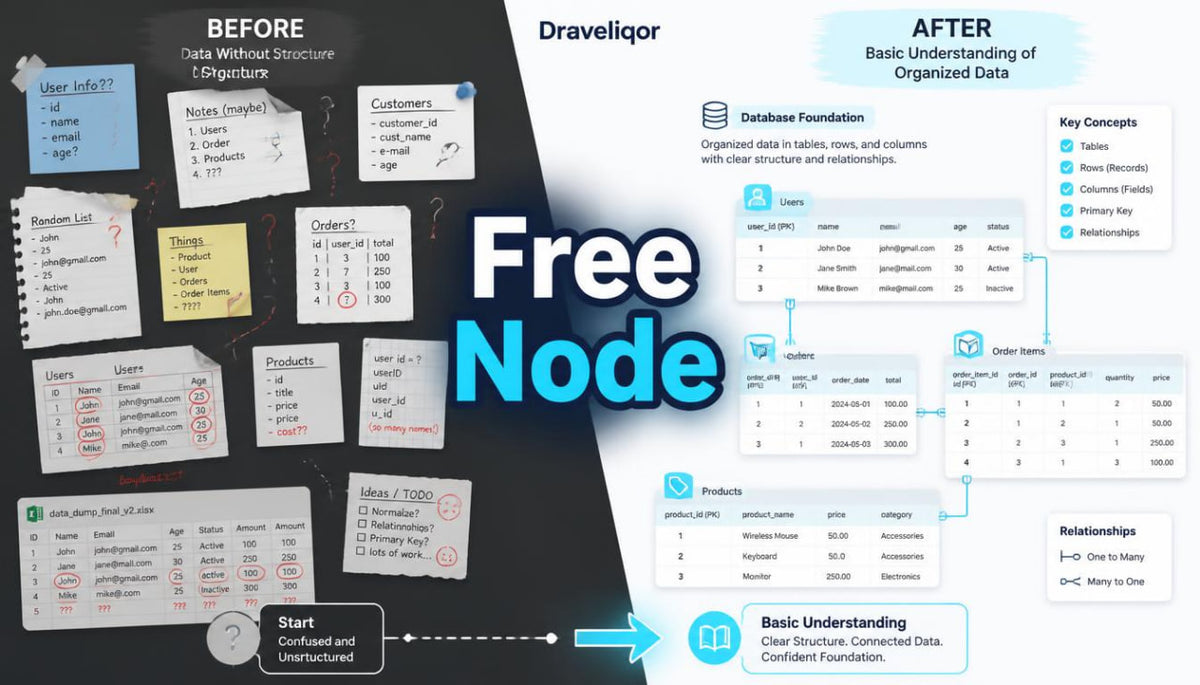
Information appears in countless forms, from personal reading lists and event schedules to inventory records and collections of related details. When these records grow without a defined structure, identifying connections, locating specific entries, and maintaining consistent information can become difficult. A collection of names, dates, categories, and descriptions may appear organized at first, yet repeated details and inconsistent formats can gradually make the information harder to interpret. Readers approaching database topics for the first time may also encounter unfamiliar terminology without understanding how individual concepts relate to everyday information tasks. Learning the principles behind records, fields, tables, and relationships provides a starting point for examining how structured information is created and maintained.
2. Solution — Finding the Logic Beneath the Records
Free Node introduces database thinking through a sequence that begins with familiar information and gradually moves toward structured data concepts. Rather than starting with complex technical operations, the course examines how individual records are formed and why consistent organization matters. Readers explore the relationships between data fields, tables, identifiers, and categories through small examples that illustrate each idea separately. Guided activities invite learners to organize sample information, recognize structural differences, and consider how records can be connected without unnecessary duplication. By the end of the course, readers will have encountered a foundational vocabulary and a collection of exercises they can revisit before studying more detailed database topics.
3. What's Inside — A First Look Beneath the Data
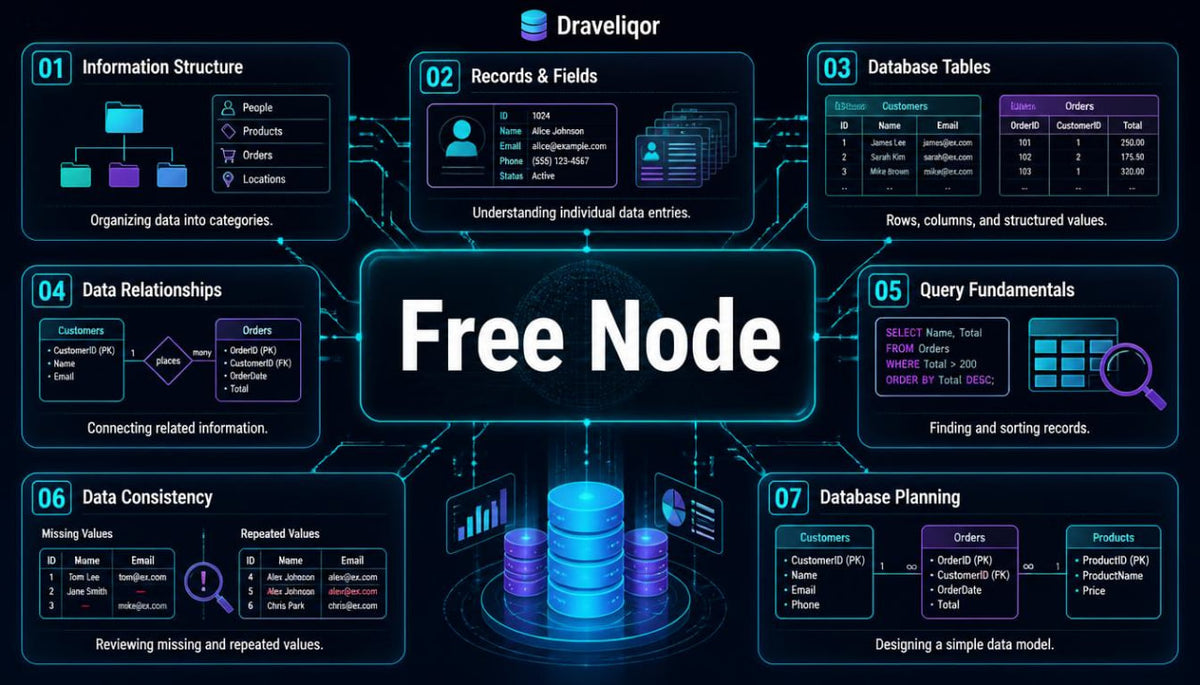
Free Node is arranged into seven introductory learning modules. Each module examines a particular part of database organization, connecting explanations with examples and short written activities.
Module 01 — Information Before Structure
The opening module explores the distinction between information collected casually and information arranged according to defined rules.
Readers begin by examining familiar collections, including reading lists, event schedules, item catalogs, and personal reference notes. These examples introduce the idea that information can be divided into recognizable categories and individual attributes.
The module discusses why consistent labels and formats matter when working with related records.
Included topics: information categories, structured records, descriptive attributes, consistency, and basic data organization.
Module 02 — The Anatomy of a Record
This module introduces records as collections of related details describing a particular item or subject.
A sample reading catalog provides the central example. Each entry contains information such as a title, category, publication year, and reference number.
Readers examine how these details can be separated into individual fields and how consistent field definitions support a coherent collection.
The activities also introduce the distinction between an individual value and the field that describes it.
Included topics: records, fields, values, identifiers, field naming, and record consistency.
Module 03 — Tables as Organized Spaces
The third module introduces tables and their role in arranging collections of records.
Readers examine the relationship between rows, columns, field definitions, and individual entries.
Illustrated examples demonstrate how related information can be arranged in a tabular structure while maintaining consistent descriptions.
A short activity invites learners to turn an unstructured collection of information into a table with clearly defined columns.
Included topics: table structure, rows, columns, field definitions, data organization, and table planning.
Module 04 — Connecting Separate Pieces
Not every detail belongs in the same table.
This module examines how different groups of information can be related while remaining organized as separate collections.
Using a fictional reading room, readers consider how book records, reader records, and borrowing records represent different kinds of information.
The module introduces identifiers and explains how references between records describe connections.
Readers also explore the distinction between one-to-one, one-to-many, and many-to-many relationships through simplified diagrams.
Included topics: relational thinking, identifiers, record connections, relationship types, and introductory references.
Module 05 — Asking Questions of Data
Once information has a structure, readers can begin considering how particular records might be located or examined.
This module introduces the conceptual foundations of data queries without requiring previous technical study.
Examples demonstrate how a question such as identifying books from a particular category can be translated into a selection condition.
Readers examine filtering, sorting, and identifying relevant fields through written examples and structured activities.
The emphasis remains on understanding the reasoning behind a query rather than memorizing technical instructions.
Included topics: query logic, selection conditions, filtering, sorting, and information retrieval concepts.
Module 06 — Keeping Records Consistent
Organized information requires attention to the way values are recorded.
This module introduces common data quality concerns, including missing entries, repeated records, inconsistent categories, and unclear field definitions.
Readers compare sample tables to identify structural differences and discuss how naming conventions and consistent formats affect interpretation.
A guided activity invites learners to revise a fictional catalog containing several organizational issues.
The module also introduces the idea of reviewing data before making structural changes.
Included topics: data consistency, duplicate records, missing values, naming conventions, and introductory validation.
Module 07 — A Small Database on Paper
The final module brings the earlier concepts into one practical planning activity.
Readers design a basic information structure for a fictional community reading room, identifying the details that need to be recorded.
The activity involves defining tables, selecting fields, assigning identifiers, and sketching connections between related records.
Learners then consider several questions that could be answered using the proposed structure.
This exercise focuses on planning and explaining a simple database model rather than building a complete technical system.
Included topics: introductory data modeling, table planning, relationship diagrams, sample records, and structural review.
Learning Activities and Supporting Materials
Alongside the seven modules, Free Node includes topic review questions, sample data collections, terminology notes, and short activities that connect individual concepts.
The exercises encourage readers to compare alternative structures, identify missing information, and explain their organizational choices.
A closing review brings the introductory terms together and provides a reference point for later database study.
4. Who Is This For? — Starting with the Building Blocks
Free Node is intended for readers who are new to database concepts and want to understand the reasoning behind organized information.
It may be suitable for students exploring data-related subjects, independent learners interested in technical foundations, or individuals who regularly work with collections of information and want to examine the principles behind structured records.
No previous database experience is required for the introductory activities.
The course focuses on conceptual understanding and written practice. Readers seeking detailed implementation methods or advanced database architecture can use this introductory material to become familiar with terminology before examining those subjects in later courses.
5. What You'll Learn — Concepts to Carry Forward
By working through the Free Node materials, readers can explore the following knowledge areas and practical activities:
-
Explain the difference between unstructured information and organized records.
-
Identify fields, values, rows, and columns within sample tables.
-
Describe how consistent field definitions contribute to data organization.
-
Distinguish individual records from collections of related records.
-
Explain the purpose of identifiers within a table.
-
Recognize common relationships between separate information collections.
-
Interpret basic one-to-one, one-to-many, and many-to-many relationship diagrams.
-
Describe the purpose of filtering and sorting information.
-
Translate simple information questions into conceptual selection conditions.
-
Identify repeated records, missing values, and inconsistent categories.
-
Arrange fictional records into a basic tabular structure.
-
Sketch an introductory database model using several connected tables.
-
Review a proposed structure and explain its organizational choices.
These learning objectives describe the subjects and activities included in Free Node. Individual progress depends on participation, previous familiarity, and time spent reviewing the materials.
6. Guarantee — 30-Day Refund Information
Free Node is offered without an enrollment charge. There is no payment required for this introductory course and therefore no course fee to refund.
For eligible paid courses within the Draveliqor collection, a 30-day money-back arrangement is subject to the terms stated in the published Refund Policy.
The risk-free description for Free Node refers specifically to its absence of an enrollment fee. It does not describe or assure particular educational, employment, or personal outcomes.
Free Node provides an opportunity to examine Draveliqor's introductory approach to database education before deciding whether to explore further course materials.
Self-paced learning overview
- 📦 Digital file available after purchase
- 🔄 Long-term availability
- 🛡️ Secure checkout
- 🔄 Content updated in 2026
What subjects are covered in Draveliqor courses?
What subjects are covered in Draveliqor courses?
Draveliqor courses explore database concepts, information organization, data relationships, query structures, and practical data management methods. Each course follows a defined topic sequence, with learning materials arranged around explanations, examples, and exercises.
Do I need previous database knowledge before enrolling?
Do I need previous database knowledge before enrolling?
The recommended background depends on the course. Introductory materials explain foundational concepts, while later courses examine more detailed database structures and workflows. Reviewing the course description can help you select a suitable starting point.
What learning materials are included in each course?
What learning materials are included in each course?
Course content is organized into written lessons, topic explanations, illustrated examples, practical activities, and review questions. The specific subjects and activities are described in each course outline.
Share