Draveliqor
Echo Library
Echo Library
Couldn't load pickup availability
1. Problem Statement — When the Information Is There but the Path Is Unclear
A database may contain carefully arranged records, yet retrieving specific information from a growing collection can involve examining substantial amounts of data. Queries that appear similar may follow different retrieval processes depending on table structures, available indexes, and the conditions applied. Without understanding the relationship between storage organization and query execution, learners may struggle to explain why certain retrieval operations require additional work. Concepts such as indexes, execution plans, composite keys, and retrieval costs can also feel disconnected when studied without a shared example. Exploring how database retrieval mechanisms interact provides a foundation for interpreting query behavior and designing organized information collections.
2. Solution — Building a Map for Every Information Request
Echo Library introduces database retrieval through a sequence of lessons that connect logical queries with the structures used to locate records. Readers examine indexing principles, search conditions, execution plans, and alternative retrieval approaches using fictional database collections. The course explains how database engines can evaluate different strategies when processing a request for information. Guided exercises invite learners to compare indexing arrangements, interpret conceptual execution plans, and identify structural factors that influence retrieval behavior. A concluding workshop brings these concepts together through the planning and evaluation of a searchable relational database library.
3. What's Inside — The Hidden Routes Through Organized Information
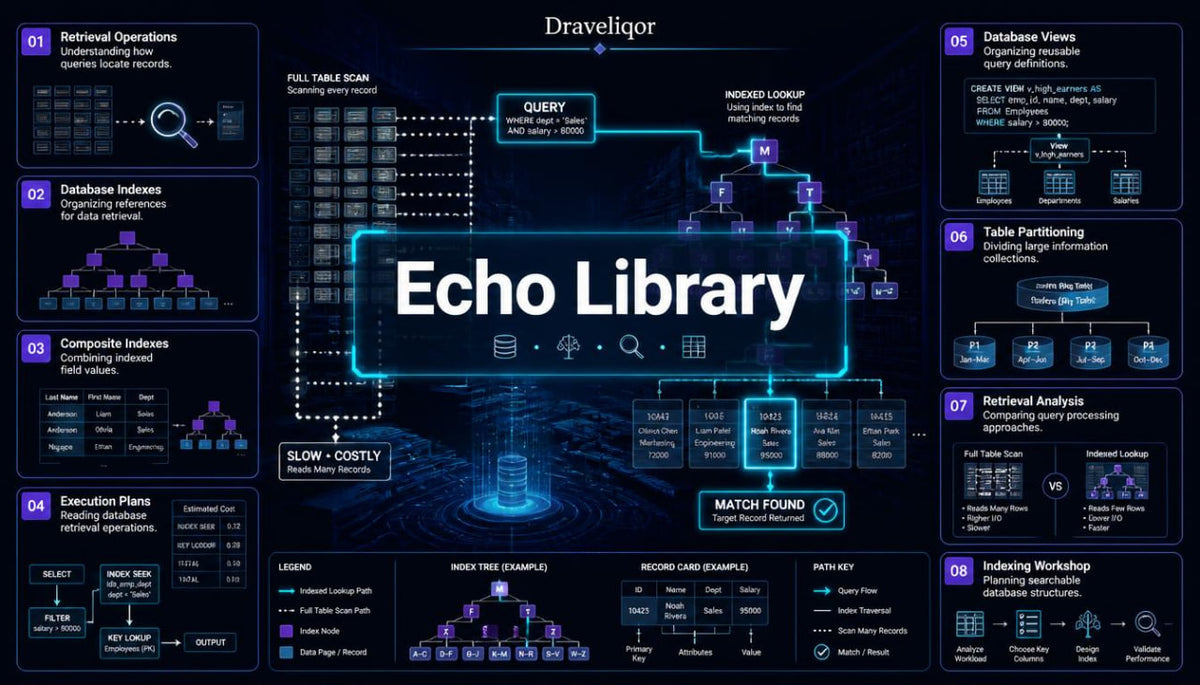
Echo Library contains eight learning modules dedicated to database indexing, structured retrieval, query planning, and information organization.
The course combines technical explanations with illustrated data structures, sample queries, conceptual execution diagrams, and practical activities.
Each module builds on familiar relational database principles while introducing additional details about how organized information can be located and examined.
Module 01 — The Journey from Query to Record
Every retrieval operation begins with a request and continues through a series of database processing decisions.
This module examines the distinction between the logical meaning of a query and the operations used to retrieve its results.
Readers explore the stages involved in identifying relevant tables, evaluating conditions, and returning matching records.
The lessons introduce sequential scans and describe why examining records individually may be appropriate in some situations.
Topics covered:
-
Logical and physical query operations
-
Database retrieval stages
-
Sequential table scans
-
Record examination
-
Selection conditions
-
Retrieval cost concepts
Practical activity: Trace a fictional information request from its original question through a sequence of record retrieval operations.
Module 02 — Indexes: Finding a Route Through the Records
An index provides an additional structure that can help a database locate particular information.
This module introduces indexing principles and explains the relationship between indexed values and the underlying table records.
Readers examine how an index differs from a complete copy of a table and why its structure matters.
Illustrated examples introduce tree-based indexing and the process of locating values through ordered references.
The module also discusses the storage and maintenance considerations associated with indexes.
Topics covered:
-
Index fundamentals
-
Indexed columns
-
Ordered references
-
Tree-based index concepts
-
Index maintenance
-
Index storage considerations
Practical activity: Compare a fictional table scan with an indexed lookup and describe the operations involved in each approach.
Module 03 — When One Column Is Not Enough
Database queries often involve conditions applied to several columns.
This module introduces composite indexes and examines how the order of indexed fields can influence retrieval behavior.
Readers compare index arrangements involving categories, dates, identifiers, and descriptive attributes.
Examples demonstrate why an index designed for one query pattern may behave differently when used with another.
The lessons also introduce selectivity and the distinction between frequently repeated values and highly distinctive values.
Topics covered:
-
Composite indexes
-
Column ordering
-
Index prefixes
-
Data selectivity
-
Multi-column conditions
-
Retrieval pattern analysis
Practical activity: Examine several fictional queries and propose index arrangements based on their filtering conditions.
Module 04 — Reading the Database's Execution Plan
A query describes the information being requested, while an execution plan describes operations selected to obtain it.
This module introduces query execution plans and their role in understanding database retrieval.
Readers examine conceptual examples involving table scans, index lookups, filtering operations, and joins.
The lessons discuss estimated record counts, operation costs, and the distinction between an estimated plan and observed execution behavior.
Illustrated diagrams demonstrate how several operations can be combined within one retrieval process.
Topics covered:
-
Query execution plans
-
Scan operations
-
Index lookups
-
Join strategies
-
Estimated record counts
-
Cost-based planning
-
Execution plan interpretation
Practical activity: Read simplified execution diagrams and describe the role of each operation within a multi-table query.
Module 05 — Views and Reusable Information Structures
Some information requests involve recurring combinations of fields, conditions, and relationships.
This module introduces database views and explores how they can represent defined queries as named structures.
Readers examine the distinction between a regular view and stored table data.
The lessons also introduce materialized views as a separate concept involving stored query results and refresh considerations.
Examples demonstrate how views can organize recurring information requests while leaving the underlying table relationships intact.
Topics covered:
-
Database views
-
Reusable query definitions
-
Underlying table references
-
Materialized view concepts
-
View maintenance considerations
-
Information presentation
Practical activity: Design a conceptual view for a fictional educational catalog that combines information from several connected tables.
Module 06 — Organizing Large Information Collections
Database retrieval becomes a broader architectural consideration when information collections contain many records.
This module examines methods for organizing large tables through partitioning and structured data separation.
Readers explore how records can be divided according to dates, categories, or other defined criteria.
The lessons distinguish partitioning from indexing and discuss how the two approaches address different aspects of information organization.
Examples also connect earlier archival concepts with the retrieval needs of current and historical collections.
Topics covered:
-
Table partitioning
-
Range-based organization
-
Category-based separation
-
Partition selection
-
Indexing and partitioning differences
-
Historical data retrieval
Practical activity: Prepare an organizational outline for a fictional activity database containing records from several years.
Module 07 — Examining Retrieval Behavior
Understanding database retrieval requires attention to both query structure and the characteristics of stored information.
This module introduces a systematic approach to reviewing query behavior through example workloads and conceptual measurements.
Readers explore why index selection, filtering conditions, table relationships, and record distribution can influence execution decisions.
The lessons examine situations where adding an index may introduce additional maintenance work without improving every retrieval operation.
Examples encourage readers to distinguish observed behavior from assumptions about database structure.
Topics covered:
-
Retrieval analysis
-
Query workload patterns
-
Index selection
-
Record distribution
-
Scan and lookup comparisons
-
Maintenance tradeoffs
-
Query review documentation
Practical activity: Compare several retrieval scenarios and prepare a written explanation of the structural factors involved.
Module 08 — The Searchable Records Workshop
The final module combines the course concepts into an integrated database retrieval planning activity.
Readers work with a fictional research library containing publications, contributors, categories, references, and historical catalog entries.
The scenario includes several information requests involving filtering, sorting, related tables, and date-based selections.
Learners examine the existing table structures before proposing indexing arrangements and reusable query definitions.
They then interpret simplified execution plans and compare alternative retrieval approaches.
The workshop concludes with a written review of indexing choices, organizational tradeoffs, and the reasoning behind the proposed retrieval design.
Topics covered:
-
Retrieval requirement analysis
-
Index planning
-
Composite index evaluation
-
Query execution interpretation
-
View design
-
Partitioning considerations
-
Structural documentation
Practical activity: Develop a retrieval design proposal for a connected fictional database, including sample queries, conceptual indexes, execution diagrams, and supporting explanations.
Supporting Learning Materials — Beyond the Search Results
Echo Library includes illustrated indexing structures, query examples, retrieval diagrams, terminology references, and practical interpretation exercises.
Worked examples demonstrate how different query conditions interact with index arrangements and table structures.
Comparison activities invite readers to examine alternative retrieval approaches and explain the reasoning behind their observations.
Additional review questions focus on identifying relevant operations, interpreting execution plans, and distinguishing indexing from broader data organization methods.
The concluding reference material brings together terminology related to indexing, execution planning, views, partitioning, and query analysis.
4. Who Is This For? — Readers Curious About the Routes Behind the Results
Echo Library is intended for learners who understand relational database structures and introductory query concepts and want to examine database retrieval in greater detail.
The course may be suitable for students studying database architecture, independent learners interested in indexing and query planning, and readers examining how structured information collections are searched.
Familiarity with tables, identifiers, joins, filtering conditions, sorting, and database relationships is recommended.
Previous experience with detailed database performance analysis is not required.
The materials emphasize conceptual reasoning, illustrated structures, and written evaluation activities.
Readers are encouraged to examine the provided examples and compare alternative retrieval methods to develop a clearer understanding of the underlying principles.
5. What You'll Learn — Understanding the Routes from Query to Result
Through the Echo Library materials, readers can explore the following knowledge areas and practical skills:
-
Explain the difference between logical queries and physical retrieval operations.
-
Describe how database records can be located through sequential scans.
-
Recognize the purpose of database indexes.
-
Interpret introductory tree-based indexing structures.
-
Explain the relationship between indexed values and table records.
-
Compare single-column and composite indexes.
-
Examine how indexed column order influences retrieval conditions.
-
Describe the role of data selectivity in index planning.
-
Identify common operations represented within query execution plans.
-
Interpret simplified scan, lookup, and join operations.
-
Distinguish estimated execution information from observed behavior.
-
Explain the purpose of database views.
-
Recognize the differences between regular and materialized views.
-
Describe introductory table partitioning concepts.
-
Compare indexing, partitioning, and archival organization.
-
Evaluate fictional query workloads and retrieval structures.
-
Document indexing decisions and their associated tradeoffs.
-
Prepare a retrieval design outline for a connected relational database.
These objectives describe the knowledge areas and exercises presented in Echo Library. Individual progress depends on prior familiarity, participation, and the time dedicated to reviewing the materials.
6. 30-Day Refund Information — Course Purchase Terms
Echo Library is a paid educational course within the Draveliqor collection.
A 30-day refund option applies to eligible purchases where the store's published Refund Policy establishes these terms.
Where applicable, customers may submit a refund request within 30 calendar days of their purchase date, following the procedure described in the policy.
Self-paced learning overview
- 📦 Digital file available after purchase
- 🔄 Long-term availability
- 🛡️ Secure checkout
- 🔄 Content updated in 2026
What subjects are covered in Draveliqor courses?
What subjects are covered in Draveliqor courses?
Draveliqor courses explore database concepts, information organization, data relationships, query structures, and practical data management methods. Each course follows a defined topic sequence, with learning materials arranged around explanations, examples, and exercises.
Do I need previous database knowledge before enrolling?
Do I need previous database knowledge before enrolling?
The recommended background depends on the course. Introductory materials explain foundational concepts, while later courses examine more detailed database structures and workflows. Reviewing the course description can help you select a suitable starting point.
What learning materials are included in each course?
What learning materials are included in each course?
Course content is organized into written lessons, topic explanations, illustrated examples, practical activities, and review questions. The specific subjects and activities are described in each course outline.
Share