Draveliqor
Drift Archive
Drift Archive
Couldn't load pickup availability
1. Problem Statement — When Yesterday's Data Meets Today's Structure
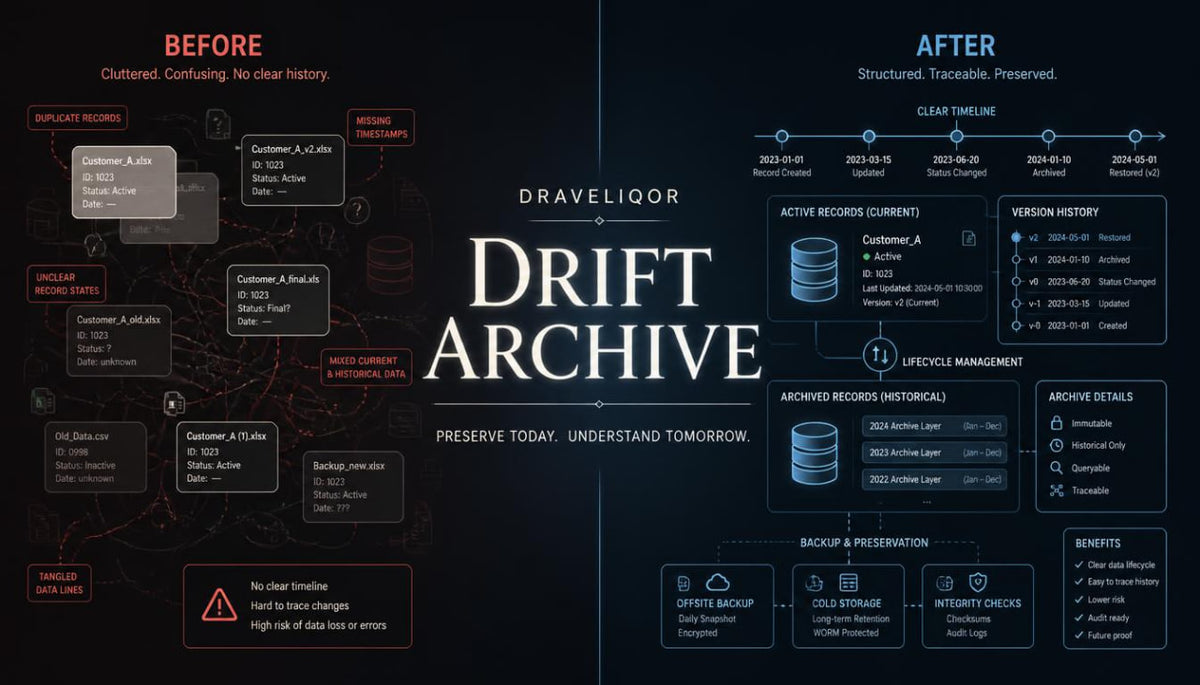
Database collections often begin with clearly arranged information, but their structure becomes more complicated as new records appear and existing values change. Historical information may become difficult to interpret when updates replace earlier details without a documented record of those changes. Repeated entries, inconsistent dates, incomplete references, and unclear retention rules can create confusion within growing collections. Learners familiar with database tables and queries may still struggle to understand how information should be maintained over extended periods. Examining data lifecycles, archival organization, and integrity principles provides a structured foundation for understanding how databases accommodate changing information.
2. Solution — Giving Information a Place Across Time
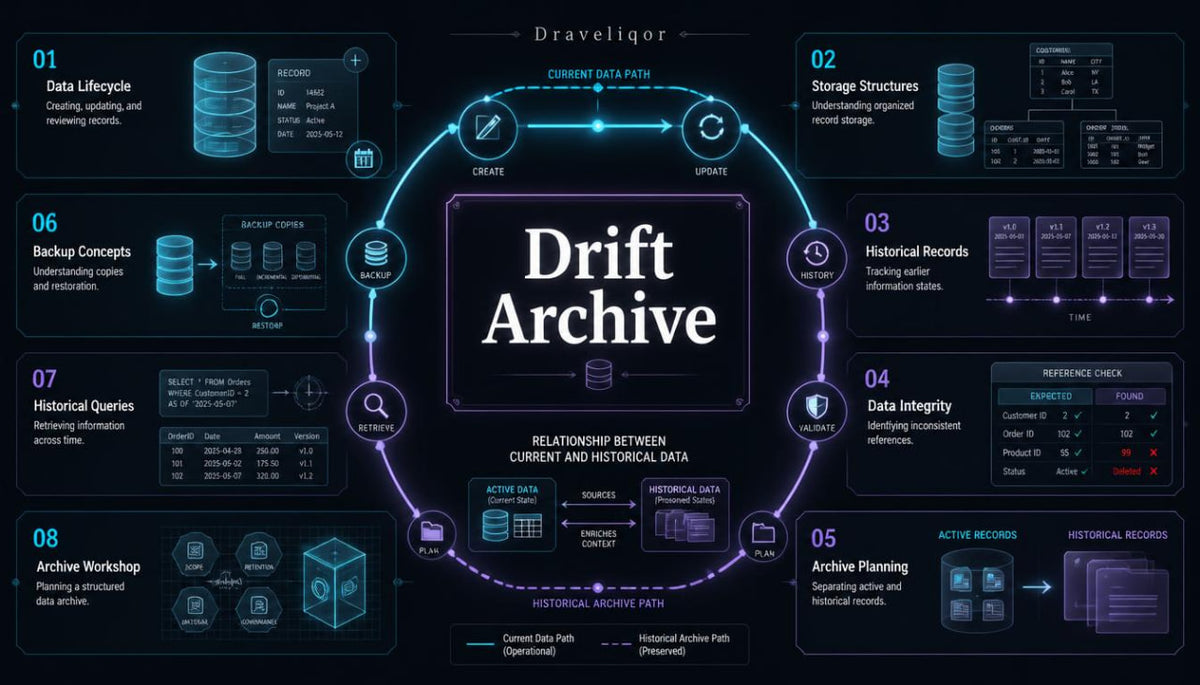
Drift Archive introduces the principles of data preservation through a sequence of lessons focused on record organization, historical information, and database maintenance. Readers examine how information moves through different stages, from initial creation to modification, review, and archival storage. The course explores methods for distinguishing current records from historical entries while maintaining meaningful relationships between information collections. Practical exercises invite learners to examine fictional datasets, identify inconsistencies, and plan structures for storing historical information. The final activities bring these ideas together through a database archival planning scenario involving connected records, retention considerations, and documented structural decisions.
3. What's Inside — Understanding the Life of a Record
Drift Archive contains eight structured learning modules covering database record lifecycles, data preservation, historical organization, and introductory archival design.
Each module combines written explanations with illustrative examples and activities that encourage readers to consider how database structures behave as information changes.
Module 01 — The Beginning of a Data Lifecycle
Every database record has a starting point, but its role may change throughout its existence.
This module introduces the concept of a data lifecycle and explains how information moves through creation, use, modification, review, and archival stages.
Readers examine fictional records from a community activity center, observing how participant details and event registrations evolve over time.
The lessons distinguish active information from historical records and explain why different stages may require different organizational approaches.
Topics covered:
-
Data lifecycle stages
-
Record creation and modification
-
Active and historical information
-
Lifecycle documentation
-
Introductory retention planning
Practical activity: Create a lifecycle diagram showing how a fictional registration record changes from its initial creation to its archival stage.
Module 02 — The Architecture of Stored Records
Database storage involves more than placing information inside tables.
This module examines how logical organization influences the interpretation and maintenance of stored records.
Readers revisit tables, identifiers, data types, and relationships while considering how these elements behave as collections expand.
The lessons introduce the distinction between logical database structures and the physical organization of stored information.
Examples illustrate why record formats, identifiers, and consistent attribute definitions matter when maintaining collections over time.
Topics covered:
-
Logical storage structures
-
Physical storage concepts
-
Record organization
-
Data type considerations
-
Storage planning
Practical activity: Review a fictional database schema and identify structural choices that may require attention as its record collection grows.
Module 03 — Keeping History Without Losing Context
Historical records can provide information about changes that are no longer visible in current entries.
This module explores methods for representing earlier record states without confusing them with current information.
Readers examine timestamps, change descriptions, version identifiers, and separate historical tables.
A fictional equipment catalog demonstrates how item descriptions, assigned locations, and status values may change over time.
The lessons also introduce the importance of preserving enough context to interpret historical values accurately.
Topics covered:
-
Historical record organization
-
Timestamp fields
-
Version identifiers
-
Change history tables
-
Current and previous record states
Practical activity: Design a simplified history table that records changes to equipment assignments while retaining references to the original items.
Module 04 — Recognizing Data Integrity Issues
Reliable interpretation depends on clear relationships and consistent information.
This module introduces common integrity concerns that may arise during database maintenance.
Readers examine missing references, duplicated identifiers, inconsistent values, and records that conflict with established structural rules.
The lessons discuss entity integrity, referential integrity, and introductory validation principles.
Examples demonstrate how changing or removing a referenced record can affect related information.
Topics covered:
-
Entity integrity
-
Referential integrity
-
Missing references
-
Duplicate identifiers
-
Validation conditions
-
Structural consistency
Practical activity: Examine sample tables containing integrity issues and propose revisions that preserve meaningful relationships.
Module 05 — The Logic of Archival Collections
Not every record needs to remain within an actively used information collection indefinitely.
This module examines the purpose of archival structures and how archived records differ from ordinary active entries.
Readers compare organizational approaches involving separate archival tables, designated record states, and date-based grouping.
The lessons introduce archival selection criteria and the importance of maintaining understandable record references.
Retention periods are discussed as requirements determined by organizational needs and applicable rules rather than universal timeframes.
Topics covered:
-
Archival structures
-
Active and archived records
-
Retention criteria
-
Archival selection
-
Historical references
-
Record classification
Practical activity: Prepare an archival outline for a fictional event database, identifying which records remain active and which may be moved into historical collections.
Module 06 — Backups, Copies, and Restoration Concepts
Archival storage and database backups serve different purposes.
This module explores the conceptual distinctions between long-term historical organization, backup copies, and database restoration.
Readers examine full and incremental backup approaches and discuss how stored copies relate to changes in the original database.
The lessons introduce recovery points, verification activities, and the importance of documenting backup procedures.
The course approaches these subjects through planning examples rather than live infrastructure administration.
Topics covered:
-
Backup fundamentals
-
Archival storage versus backups
-
Full and incremental copies
-
Restoration planning
-
Recovery points
-
Backup verification concepts
Practical activity: Compare three fictional data preservation plans and explain the purpose of each approach.
Module 07 — Finding Information Across Time
Historical collections remain useful when their records can be located and interpreted.
This module explores how queries interact with current and archived information.
Readers consider how dates, record identifiers, and historical status fields influence retrieval conditions.
The lessons introduce time-based filtering, historical comparisons, and the importance of consistent relationships between active and archived tables.
Examples demonstrate how a request for a past record state differs from a request for current information.
Topics covered:
-
Historical query logic
-
Date-based filtering
-
Record version selection
-
Retrieval from archival tables
-
Comparing record states
Practical activity: Prepare query outlines for locating historical registration records and examining changes between selected dates.
Module 08 — The Archive Planning Workshop
The final module combines the course concepts into an integrated database planning activity.
Readers work with a fictional educational center containing learner registrations, scheduled sessions, attendance records, and historical course information.
The scenario introduces changing record values, completed activities, inactive registrations, and archival requirements.
Learners develop a proposed structure that separates current records from historical information while preserving relevant relationships.
The workshop concludes with a written review of integrity considerations, archival criteria, backup concepts, and retrieval needs.
Topics covered:
-
Lifecycle planning
-
Historical schema design
-
Integrity review
-
Archival classification
-
Preservation planning
-
Historical information retrieval
Practical activity: Develop a database archival plan with connected table outlines, history fields, record classifications, and supporting explanations.
Supporting Learning Materials — Beyond the Main Modules
Drift Archive includes sample datasets, conceptual diagrams, terminology notes, and review activities connected to the eight modules.
Worked examples illustrate the differences between updating a record, preserving an earlier version, and creating an archival entry.
Comparison exercises encourage readers to examine alternative structures and describe the reasoning behind their choices.
A closing review brings together lifecycle terminology, integrity principles, historical relationships, and archival planning concepts.
4. Who Is This For? — Understanding Data Beyond Its First Entry
Drift Archive is intended for learners who have encountered introductory database structures and want to examine how information can be organized over time.
The course may be suitable for students studying database management, independent learners exploring historical records, and individuals interested in the design of structured information collections.
Familiarity with tables, relationships, identifiers, and introductory queries is recommended.
Readers do not need previous experience managing live database infrastructure.
The lessons focus on planning, interpretation, and conceptual data preservation through written exercises.
5. What You'll Learn — Following Information Through Time
Through the Drift Archive materials, readers can explore the following knowledge areas and practical skills:
-
Describe the stages of a database record lifecycle.
-
Distinguish active records from historical information.
-
Explain how database structures accommodate changing values.
-
Recognize the purpose of timestamps and version identifiers.
-
Design introductory historical record tables.
-
Interpret relationships between current and previous record states.
-
Identify common data integrity concerns.
-
Explain entity and referential integrity principles.
-
Recognize missing references and inconsistent record values.
-
Compare approaches to organizing archived information.
-
Describe the role of record retention criteria.
-
Distinguish archival storage from backup copies.
-
Explain introductory database restoration concepts.
-
Interpret date-based historical retrieval conditions.
-
Prepare an archival structure for a fictional database.
-
Document decisions concerning record preservation and organization.
These learning objectives describe the topics and practical activities included in Drift Archive. Individual progress depends on prior knowledge, participation, and time spent reviewing the materials.
6. 30-Day Refund Information — Clear Purchase Terms
Drift Archive is a paid educational course within the Draveliqor collection.
A 30-day refund option applies only where the store's published Refund Policy provides that period and the purchase meets its stated conditions.
Under such a policy, eligible customers may submit a refund request within 30 calendar days of their purchase date.
Self-paced learning overview
- 📦 Digital file available after purchase
- 🔄 Long-term availability
- 🛡️ Secure checkout
- 🔄 Content updated in 2026
What subjects are covered in Draveliqor courses?
What subjects are covered in Draveliqor courses?
Draveliqor courses explore database concepts, information organization, data relationships, query structures, and practical data management methods. Each course follows a defined topic sequence, with learning materials arranged around explanations, examples, and exercises.
Do I need previous database knowledge before enrolling?
Do I need previous database knowledge before enrolling?
The recommended background depends on the course. Introductory materials explain foundational concepts, while later courses examine more detailed database structures and workflows. Reviewing the course description can help you select a suitable starting point.
What learning materials are included in each course?
What learning materials are included in each course?
Course content is organized into written lessons, topic explanations, illustrated examples, practical activities, and review questions. The specific subjects and activities are described in each course outline.
Share