Draveliqor
Anchor Framework
Anchor Framework
Couldn't load pickup availability
1. Problem Statement — When a Database Needs a Steady Foundation
As database environments develop, maintaining consistent operation becomes an important consideration alongside the organization of stored information. Changes to data structures, unexpected interruptions, incomplete operations, and inconsistent maintenance practices can introduce difficulties that affect how information is managed. Even a carefully designed database may require additional procedures for monitoring its condition, reviewing structural changes, and preparing for restoration after an interruption. Learners familiar with database architecture may find it challenging to connect theoretical reliability concepts with the practical decisions involved in maintaining a data environment. Studying operational stability, recovery planning, integrity verification, and database maintenance provides a structured approach to understanding these responsibilities.
2. Solution — Creating Structure Around Database Operations
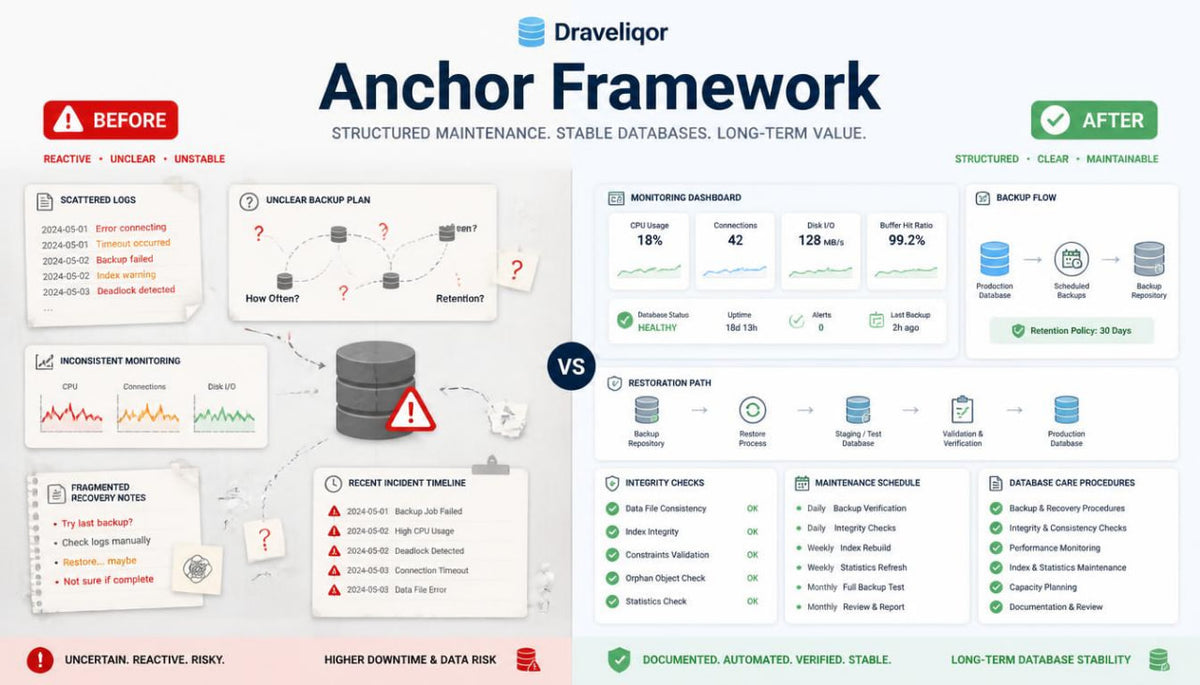
Anchor Framework introduces database reliability through a sequence of lessons focused on operational organization, system observation, and recovery planning. Readers examine how database environments can be documented, monitored, reviewed, and maintained through defined procedures. The course explores backup strategies, restoration concepts, integrity checks, structural changes, and the interpretation of operational information. Guided activities invite learners to evaluate fictional database environments, identify maintenance requirements, and prepare written operational plans. A concluding workshop combines these concepts into a database maintenance framework containing monitoring procedures, recovery considerations, and documented responsibilities.
3. What's Inside — The Foundations That Keep Data Organized
Anchor Framework contains eight detailed learning modules dedicated to database reliability, operational maintenance, and continuity planning.
The materials combine technical explanations, maintenance scenarios, illustrated workflows, sample checklists, and independent exercises.
Each module examines a different responsibility involved in maintaining a structured database environment.
Module 01 — Understanding the Operational Landscape
Database operations involve a combination of technical structures, maintenance routines, and documented responsibilities.
This opening module examines how database architecture relates to everyday operational activities.
Readers explore the distinction between database design and database maintenance, including how each area contributes to the organization of stored information.
The lessons introduce operational requirements, database components, maintenance schedules, and documentation practices.
Topics covered:
-
Database operational environments
-
Maintenance responsibilities
-
Infrastructure components
-
Operational documentation
-
Maintenance schedules
-
Database condition indicators
Practical activity: Prepare an operational overview for a fictional database environment, identifying its main components and recurring maintenance requirements.
Module 02 — Observing the Health of a Database
Understanding database behavior requires examining information about its current operating condition.
This module introduces monitoring principles and the interpretation of database activity indicators.
Readers examine connection counts, storage consumption, query duration, transaction activity, and resource utilization.
The lessons explain how measurements can be collected over time and compared against established reference conditions.
The distinction between routine variations and unusual operating patterns is also discussed.
Topics covered:
-
Database monitoring concepts
-
Resource utilization
-
Connection activity
-
Query duration measurements
-
Transaction monitoring
-
Operational indicators
-
Historical measurement comparisons
Practical activity: Examine fictional monitoring records and identify changes that may require additional investigation.
Module 03 — Preparing Information for Recovery
Data preservation requires deliberate planning around what should be copied, when copies should be created, and how they should be maintained.
This module explores backup strategies and their relationship to database recovery.
Readers compare full, incremental, and differential backup approaches.
The lessons examine backup schedules, storage separation, retention criteria, and the importance of checking backup records.
A separate discussion clarifies why archival storage and backup procedures serve different operational purposes.
Topics covered:
-
Database backup planning
-
Full backups
-
Incremental backups
-
Differential backups
-
Backup schedules
-
Retention considerations
-
Backup verification
Practical activity: Develop a backup schedule for a fictional database containing active registrations, historical records, and periodically updated reference information.
Module 04 — Understanding the Path Back to Operation
A backup represents one part of a broader recovery process.
This module introduces restoration planning and examines the sequence of activities involved in returning a database to a defined state.
Readers explore recovery point objectives and recovery time objectives as planning concepts.
The lessons discuss how restoration procedures depend on backup arrangements, recorded changes, and the condition of the database environment.
Examples demonstrate why recovery documentation and periodic restoration exercises matter.
Topics covered:
-
Database restoration principles
-
Recovery point objectives
-
Recovery time objectives
-
Restoration sequences
-
Recovery documentation
-
Restoration testing
-
Recovery plan review
Practical activity: Prepare a written restoration procedure for a fictional information system following an interrupted database operation.
Module 05 — Following the Evidence in Database Activity
Operational records can provide valuable information about database behavior.
This module examines database logs, event records, and introductory audit concepts.
Readers explore how recorded events can describe connections, modifications, interrupted transactions, and maintenance activities.
The lessons introduce event timestamps, severity classifications, and the relationship between logs and operational investigations.
Particular attention is given to interpreting records within their wider technical context rather than treating isolated messages as complete explanations.
Topics covered:
-
Database event logs
-
Operational event records
-
Audit trail concepts
-
Error classification
-
Event timestamps
-
Activity documentation
-
Incident investigation
Practical activity: Review fictional database event records and construct a timeline describing the sequence of observed activities.
Module 06 — Preserving Integrity Through Routine Checks
Database integrity requires attention to structural rules and the condition of stored records.
This module examines how integrity checks can be incorporated into maintenance procedures.
Readers revisit primary key rules, foreign key relationships, uniqueness constraints, and data validation.
The lessons explore how inconsistencies can arise during incomplete modifications, data transfers, or structural revisions.
Examples demonstrate how routine reviews can identify issues that require further examination.
Topics covered:
-
Integrity verification
-
Referential consistency
-
Constraint evaluation
-
Missing relationships
-
Duplicate record analysis
-
Validation procedures
-
Integrity reporting
Practical activity: Examine a fictional database containing inconsistent references and prepare an integrity review report with proposed corrective actions.
Module 07 — Changing the Structure Without Losing the Context
Database structures may need to evolve as information requirements change.
This module introduces schema maintenance and the planning involved in modifying established database structures.
Readers examine changes to tables, attributes, relationships, and constraints.
The lessons discuss schema migrations, compatibility considerations, and the importance of documenting changes before and after implementation.
Examples illustrate why a structural modification should be evaluated in relation to existing records and dependent operations.
Topics covered:
-
Schema evolution
-
Structural modification planning
-
Database migration concepts
-
Compatibility considerations
-
Change documentation
-
Migration verification
-
Reversal planning
Practical activity: Prepare a proposed schema modification for a fictional database and document the steps needed to review the change.
Module 08 — The Database Continuity Workshop
The final module combines operational observation, preservation planning, recovery concepts, and structural maintenance within one integrated activity.
Readers work with a fictional regional learning center that maintains several connected databases for registrations, schedules, attendance, and historical records.
The scenario includes an expanding record collection, a planned schema revision, inconsistent references, and a simulated interruption.
Learners prepare a maintenance framework that identifies monitoring requirements, backup arrangements, restoration steps, and integrity review procedures.
The workshop concludes with a written evaluation of operational responsibilities and a documented plan for reviewing the database environment over time.
Topics covered:
-
Operational planning
-
Database monitoring
-
Backup arrangements
-
Restoration procedures
-
Integrity verification
-
Schema maintenance
-
Incident documentation
-
Operational review
Practical activity: Create a database continuity plan containing maintenance checklists, monitoring indicators, recovery procedures, and structural review notes.
Supporting Learning Materials — The Details Behind Reliable Operations
Anchor Framework includes supporting diagrams, fictional database activity records, maintenance worksheets, terminology references, and guided review questions.
Worked examples demonstrate how operational information can be interpreted within broader database maintenance scenarios.
Readers compare alternative backup arrangements, restoration procedures, and schema modification plans.
The additional activities encourage clear documentation and the evaluation of technical decisions.
A concluding reference section connects monitoring, integrity, recovery, and maintenance concepts into one organized learning resource.
4. Who Is This For? — Learning to Think Beyond Database Design
Anchor Framework is intended for readers who understand relational database concepts and want to examine how structured information environments are maintained.
The course may be suitable for students exploring database administration concepts, independent learners interested in operational reliability, and readers examining the relationship between database architecture and maintenance procedures.
Familiarity with tables, queries, transactions, indexing, and introductory database architecture is recommended.
Previous experience administering live infrastructure is not required.
The learning activities focus on conceptual planning, written procedures, technical interpretation, and the evaluation of fictional database scenarios.
Readers are encouraged to work through the maintenance exercises and compare different approaches to operational organization.
5. What You'll Learn — Building a Clear Operational Perspective
Through Anchor Framework, readers can explore the following knowledge areas and practical skills:
-
Describe the responsibilities involved in database maintenance.
-
Identify operational components within a database environment.
-
Explain the purpose of database monitoring.
-
Interpret introductory operational measurements.
-
Recognize changes in query duration and resource utilization.
-
Compare full, incremental, and differential backup approaches.
-
Develop introductory backup schedules.
-
Distinguish archival organization from backup procedures.
-
Explain recovery point and recovery time objectives.
-
Describe the stages of database restoration.
-
Interpret database event records and operational timelines.
-
Recognize common integrity and validation concerns.
-
Prepare an introductory data integrity review.
-
Explain the purpose of schema maintenance.
-
Identify considerations involved in database migrations.
-
Document proposed structural changes.
-
Develop operational maintenance checklists.
-
Prepare a database recovery planning document.
-
Evaluate fictional operational incidents.
-
Combine monitoring, preservation, and maintenance concepts into a structured database continuity plan.
These learning objectives describe the knowledge areas and exercises included in Anchor Framework.
The course emphasizes technical understanding, procedural documentation, and the careful evaluation of database operations.
Individual progress depends on prior knowledge, participation, and time spent reviewing the materials.
6. 30-Day Refund Information — Course Purchase Terms
Anchor Framework is a paid educational course within the Draveliqor collection.
A 30-day refund option applies to eligible purchases where the store's published Refund Policy establishes these terms.
Under such an arrangement, eligible customers may submit a refund request within 30 calendar days of their purchase date.
Self-paced learning overview
- 📦 Digital file available after purchase
- 🔄 Long-term availability
- 🛡️ Secure checkout
- 🔄 Content updated in 2026
What subjects are covered in Draveliqor courses?
What subjects are covered in Draveliqor courses?
Draveliqor courses explore database concepts, information organization, data relationships, query structures, and practical data management methods. Each course follows a defined topic sequence, with learning materials arranged around explanations, examples, and exercises.
Do I need previous database knowledge before enrolling?
Do I need previous database knowledge before enrolling?
The recommended background depends on the course. Introductory materials explain foundational concepts, while later courses examine more detailed database structures and workflows. Reviewing the course description can help you select a suitable starting point.
What learning materials are included in each course?
What learning materials are included in each course?
Course content is organized into written lessons, topic explanations, illustrated examples, practical activities, and review questions. The specific subjects and activities are described in each course outline.
Share